Posts

Showing posts with the label history

Cherry Bounce, Part 2
Image
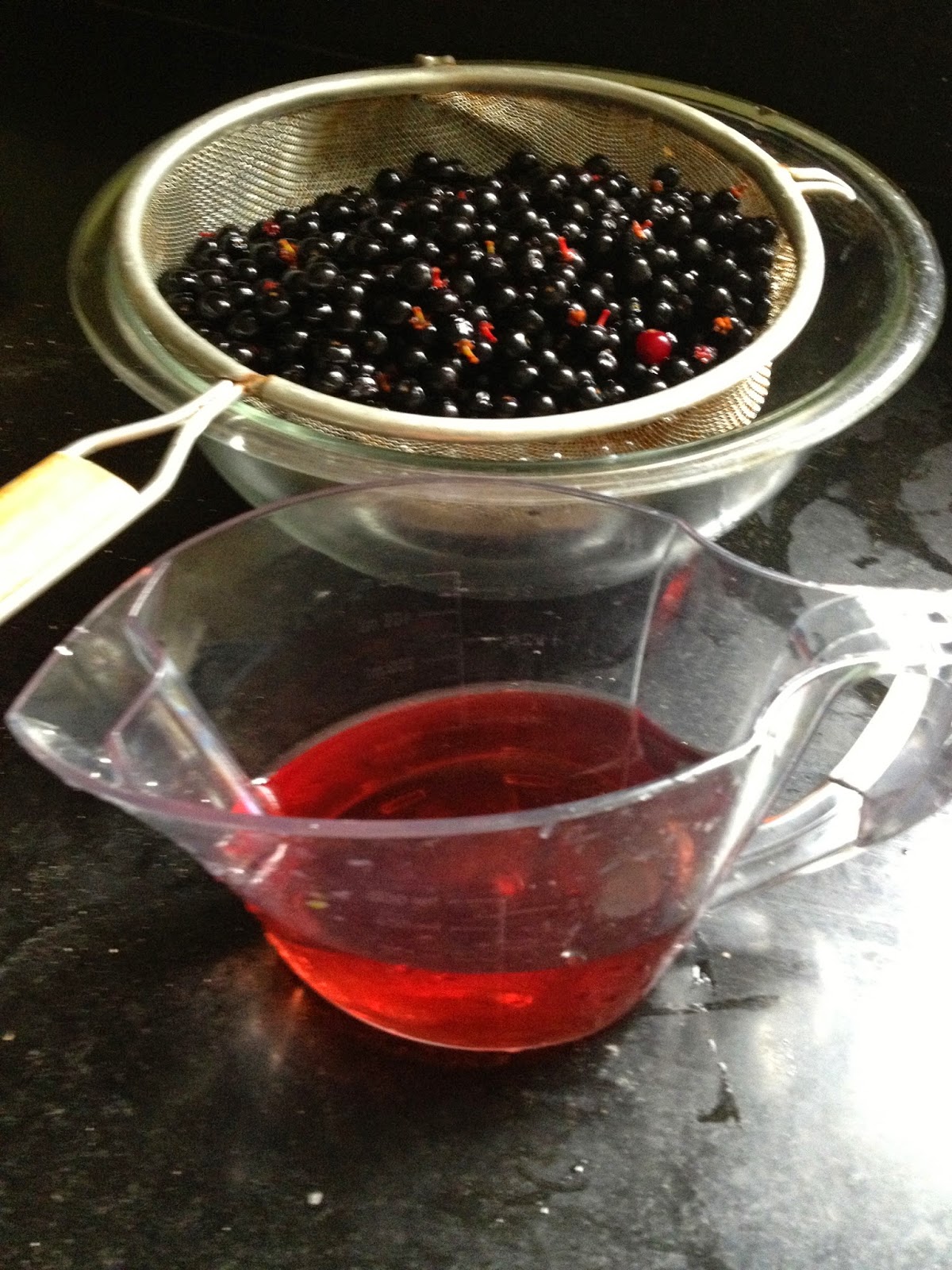
Yesterday I started making Cherry Bounce by soaking our foraged chokecherries in water overnight. Now that they are done soaking, it's time to finish mixing up our ingredients for this colonial-era cordial. We're ready to move on. Step three: Drain the chokecherries, reserving 1 cup of the soaking liquid: As you can see, what was plain water yesterday is now a lovely cherry red color. It doesn't taste like much of anything yet, but it sure is pretty. Step four: Add the reserved liquid plus 2 cups of sugar to the chokecherries: Because we are in the height of pickling season, I didn't have an available container large enough for a quart of chokecherries plus a quart of rum and all that sugar. Instead, I used four wide-mouth, quart-sized mason jars, which meant I had to further divide down the recipe to have tiny proportions of the ingredients. This is a really easy way to do it, though, and is perfect if you only have a small amount of fruit or ju...

Cherry Bounce, Part 1

Image
Do you have one of these in or near your yard? If you have lots of little purple berries getting squished underfoot on your sidewalk or driveway, or are hearing lots of birds squabbling in the early morning, look up. You might notice some of these:  This is a chokecherry tree, a native cherry tree with small, tart fruit. (Tart is probably an understatement,  or at least is only accurate when they are very ripe, as the ones in the picture are. ) Some people call them pin cherries or bird cherries.  These trees are kind of weedy, and we have several. One is a bushy monster near the fire hydrant out front, and the several more are taller and more obviously tree-like, but are technically on the neighbor's property along the line our driveways share. But lots of the long, willowy branches hang over the fence onto our side of the driveway, and that's good news for us, since you can use these guys to make a traditional colonial cordial called Cherry Bounce. ...

Glass Houses

Image
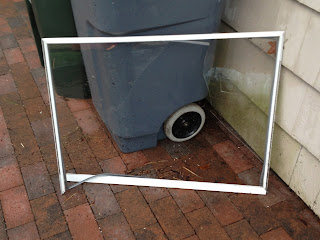
Any hope of me overcoming my new obsession with hot beds  in the near future was destroyed today, by the same wind that took out another window of our cold frames: It was really gusty today, and when I got home, six of the eight glass windows that we use to cover our cold frames had been tossed around to other parts of the garden. Luckily only one broke, but now we are down to just seven, and that means that one of our cold frames is done for the year, because we need eight windows to cover both completely. And if it's not completely closed up, it obviously won't work. So I put away the three remaining windows that had been over the frame with cilantro, fennel, and dill, leaving them to certain death when temperatures drop again. I also reinforced the windows over the cold frame with the salad greens, weighing them down with bricks:  But really, is this any way to live? I had to re-batten down a lot of the plastic on the greenhouse tunnels too, for like the 5...

Victorian Kitchen Garden

Image
Recently Kirk found something new to get us through the winter months. It's a little BBC show from the 1980s called "Victorian Kitchen Garden," and it is awesome: It's like a precursor to those great PBS shows like "Frontier House" and "Manor House" that they used to make, where people recreate everyday life in a historical time period. This lacks the costume-y nature of those shows, but these guys use their research and first-hand knowledge from some of the last old-time estate gardeners in England to bring a decrepit garden back to its full Victorian splendor. And since this is more about food than flowers, it's super interesting. In a quiet, old-guy-narrating-a-BBC-documentary way. I think Jonas half-expects a knight to come riding by and stab people. Anyway, Episode 2 has given me fresh food for thought in the winter gardening arena. It's all about nineteenth century greenhouses (kinda expensive to heat, but so beautiful) and, m...

House History

Image
While we were preparing for the arrival of Hurricane Sandy, Kirk was cleaning out around the bulkhead to bring in loose items (like our rain barrels, for example). But he made an outstanding discovery, which sidetracked us for a couple hours: an old newspaper from August 31, 1931. It's dusty and crumpled and in several pieces, but we love stuff like this, so spent some time piecing it back together: The paper is The Advertiser , which was the first daily newspaper in Boston. It was acquired by William Randolph Hearst and eventually died off. By the date of this piece, they were just using the name for their Sunday paper. And what we have definitely has the feel of a Sunday paper, complete with an arts section (devoted to radio plays, as you can see in the photo above), travel articles, and an advice column. There are also plenty of ads, my favorite of which is below. Check out the new car and fashionable hats: Another page includes a decorating advice column. ...

Sharing Heirloom Seeds

Image
This weekend we went to the New Hampshire Fall Festival at Strawbery Banke . We bought a membership this year, in no small part for the express purpose of watching their gardens change throughout the season. This time we got to see border collies herding sheep and goats (which was totally awesome), a team of oxen pulling a cart on skids, and several other animals (Tiegan may want an angora rabbit to pet and for fiber crafts — we'll see if she can sneak that past Kirk, who has his own interest in eating rabbit).  Another table we spent a good deal of time at was the heirloom seed table, sponsored by  Slow Food Seacoast . They staff the table with expert gardeners who grow and save seeds from many heirloom varieties, and they'll give you a packet of seeds of whatever you ask for. They're loaded with information and advice. We picked up several: I snagged angelica seeds (an herb I have been reading about as for old fashioned sweets, but haven't been able to ...

Garden Tour: The Sherburne Garden at Stawbery Banke

Image
This weekend we visited Strawbery Banke in Portsmouth, New Hampshire. This is a historic preservation area much like Colonial Williamsburg, but the houses there are interpreted in several different time periods instead of the whole village being in just one era. The time spans from the earliest settlements in Portsmouth in the 17th century through the 1940s and 1950s. In addition to the preserved buildings, there are also several gardens that span the centuries . The 17th century garden is the Sherburne Garden , and it features raised beds and symmetrical designs that are from the same world of ideas that we looked at while designing our own garden. When you enter the garden through the picket fence, you have a chance to pick up a large map of all the plantings. These are fantastic — everything is color-coded and clearly labeled, including the variety of vegetable you are looking at. This garden runs near a reconstructed stone foundation uncovered in a fairly recent archeological...

Tales From the Green Valley

Image
Once upon a time, in the bleak midwinter, we would get depressed. I don't think this is unusual in and of itself, but we used to channel our Seasonal Affective Disorder  by plotting grand plans of escape and/or renovation: the unbuilt garage-mahal, the kitchen remodel, the first garden re-do at the Red House, an untaken sabbatical in England. It should come as no surprise that we moved to Newburyport during the Winter Solstice. Some things come to fruition; other plans are shelved as the days get longer. One of our lingering fantasies from the dark days is the idea that we should pick up and move to England. Or Wales. (And yes, we are aware that winters are actually darker there. Nobody claims this is logical.) We actually almost did it once, going so far as to applying for work visas and taking tests to prove we are competent speakers of English. (Alas, U.S. workers have to jump through many more hoops that their E.U. counterparts, which makes no sense as the linguistic and cul...

Garden Tour: The Colonial Nursery

Image
The Colonial Nursery is a actually one of the sites that you can visit without purchasing a ticket to all of Colonial Williamsburg. This is because, in addition to being a period garden, it is also a store. All the shops are open to the public at large, so it is possible to do some sightseeing on the cheap if you are so inclined.  Below is a photo of the fall garden. You can see, of course, lots of greens and brassica. In the center of the bed are leeks: We have been thinking about leeks in the last few days. Kirk is currently reading John Seymour's The Self-Sufficient Life and How to Live It , and his description of leeks is worth sharing: In cold, wet areas, this is one of the most useful plants, for it stands the winter and provides good  food and vitamins in the months when little else has survived except kale. Onions are hard to grow  and to keep, but leeks are an easy substitute. The Welsh are very sensible to have this excellent plant  as an em...

Garden Tour: Governor's Palace Pleasure Gardens

Image
I have a feeling most visitors to Colonial Williamsburg do their ooh-ing and ahh-ing over the pleasure gardens at the Governor's Palace, not the vegetable garden . They are lovely, although definitely less lush in November than they must be in the height of the summer. Still, the "bones" of a Colonial garden, especially in the South, consists of its boxwood hedging and edges, and that part is every bit as green and beautiful at this time of year — perhaps more so, since without all the flowers, the architecture of the boxwood gets top billing. First stop? The maze: This photo gives a good idea of the scale of the privet maze. The kids really enjoyed it, although I don't think it was as challenging as I remember it being. As you can see in the photo just to the left of the children, not all of the hedges are fully filled in. I'm not sure if this was due to the time of year or a recent pruning, or if the bushes are just in a phase of being thinner than in...

Garden Tour: Governor's Palace Kitchen Garden

Image
After exploring Great Hopes Plantation , we continued on into Colonial Williamsburg proper to the Governor's Palace . After the tour of the inside of the building (which has been recently redecorated, by the way, to reflect what it would have been like with a family living there instead of just a bachelor governor), we went out to the grounds. In the South, colonial kitchens were housed in an outbuilding. Below you can see the (quite large) kitchen for the Palace: The brick kitchen buildings stand at the top of a terraced kitchen garden that extends quite a distance down the slope to a pond. It is hidden from passersby on the street by the brick wall. The Palace itself is behind what we see of the kitchen here. Not surprisingly, we see kale and collards in these beds, as well as some fruit trees on the ends that are going dormant (my guess was figs and peaches, but it's hard to tell when they are almost bare). This view of the kitchen is from the bottom of the...

Garden Tour: Great Hopes Plantation

Image
If you've been wondering why I haven't posted in a while, there are two reasons. First, I have been in and out of the hospital for a heart condition (no worries — I'm cured!). Second, last weekend we traveled to Richmond, Virginia to visit friends and for Kirk's first marathon (no worries there either — he finished!). Since I am staying home to rest from now through Thanksgiving weekend, I will share some of the excellent gardens and farms we visited on our trip. First up, Colonial Williamsburg. Kirk and I have been to Colonial Williamsburg several times, but this was the kids' first visit. It had been about a decade since our last visit, though, so we were excited to find a new area: the Great Hopes Plantation . This is a re-creation of a Virginia farm around the 1770s, and it shows traditional gardening and farming techniques as well as what life would have been like for slaves of the era. There's still quite a bit going on in the farm garden. Will...