Posts

Showing posts with the label celery

2017 Master Plan: The Workshop Quadrant

Image
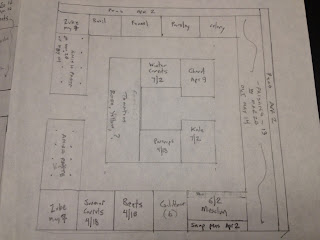
Working our way around the garden, we come to the workshop quadrant. I guess we could also call this the office quadrant, since it forms the bulk my view during the day. Here’s what I’ll be gazing out at when I’m procrastinating: In the center C are celery and parsley, zucchini, cantaloupe, and a Sungold tomato plant. The Sungold, celery, and parsley are partially shaded, which should be fine. It should help slow the ultra-prolific Sungold down to a manageable harvest level, and celery and parsley will do well with some shade in the summer anyway. Across the top, as always, are our perennial grapes and herbs. In the upper portion of the right side is a succession planting of dill. This is the shadiest section of the garden, but dill is basically a weed and will do fine here. Below that is a semi-shaded section that will lie fallow for most of the season until we plant next winter’s spinach and mache in a cold frame. Across the bottom is a long trellis of peas and a r...

The Celery Harvest

Image
Though there were times during this summer’s drought when our celery was yellow and sprawled flat on the ground — rather like a cartoon version of a thirsty plant — it recovered really well this fall: That’s the celery growing in our greenhouse tunnel, and it’s really robust — pretty much the best we’ve ever done with it. I attribute this to our long autumn growing season. We had a late frost, and the nightly lows just haven’t fallen much below 30 until this week. Celery does well in cool weather and can handle some frost, so it’s been loving life in the tunnel this season. Alas, the high  temperature by the weekend will only be 27, so this week we’re working our way through the most tender items in the tunnel to eat it all up before the deep freeze. The tunnels offer some protection from the cold, but won’t be able to keep things alive once temperatures start hitting the teens.  This celery is nice enough to eat raw, and the ribs are actually wide enough...

2016 Master Plan: The Driveway Quadrant

Image
The final quadrant of our planning for the upcoming growing season is the one nearest to the driveway: Along the top is a long trellis of peas, which is on the northern end of the bed so as not to shade the zucchini and annual herbs grown in the rest of the area (basil, fennel, parsley, and celery). To the right is another 27-foot trellis of peas. We don't usually orient them this way, but since it's to the east, we are confident that the Roma tomatoes behind it will get enough afternoon sun. The peas will also be gone by July, well before we expect to harvest any tomatoes anyway. Along the bottom are crops that can handle a bit of shade from the house as fall comes. Here we have another zucchini plant, summer carrots, beets, mesclun lettuce for the summer, and a short trellis of snap peas. We also have a block marked out for something new: cauliflower. I have never been a big fan, though my distaste has probably always had more to do with the whiteness of the wh...

The Barter Economy

Image
What's the price of maple syrup? I'm not sure how much we're talking about in USD, since we haven't bought any in a few years , but we just traded some for four (!!) live lobsters (okay, so one was missing a claw, but still). One of the doctors Kirk works with has a boat, and this spring he took a pint of this year's maple syrup in trade for the promise of summer fish. We were hoping for some blue fish, but with the season coming to an end, he hadn't gotten much of anything. So a couple nights ago he came to the door with a cooler full of lobsters from his traps. We kept them in a bowl in the mini fridge on the porch (no need to terrify the children), and tonight Kirk steamed them up: I will admit that I have no interest in cracking open a lobster and fighting to dig out the meat, and Kirk did yeoman's work on picking all four of these. After putting the shells and legs into a pot with celery, carrots, onion and parsley to make some lobster stock ...

Kids' Corner: Beef Stew and Herbed Dumplings, à la Kreacher

Image
Last weekend Tiegan and Jonas worked together to make Kirk's birthday present: Sunday dinner! Tiegan spent some of her Christmas money at the book store, and one of the items she was most excited about was The Unofficial Harry Potter Cookbook: From Cauldron Cakes to Knickerbocker Glory: More than 150 Magical Recipes for Muggles and Wizards . After paging through it, the kids decided to make Beef Stew with Herbed Dumplings for Kirk. And with only a quick consult with me about how sear the meat, they did it all on their own.  I didn't even hear any shouting, so it must have been fun. Here's how they did it: Tiegan: We cut the onion, carrots, and the celery into kind of big pieces. We also made dough for the dumplings out of flour, eggs, milk, and herbs. I picked oregano, sage, and thyme. Then we covered the dough and put it in the fridge. Jonas: I cut the potatoes by taking each potato and cutting it in wheels. Then I cut each wheel into quarters. It...

Sweet Potato and Chorizo Soup

Image
It is cold. As I sit typing away, the wind is shrieking straight out of the north. It is a mere 6 degrees in the garden right now, and it's likely that the last turnips and greens will be dead tomorrow, even if the plastic tunnels don't come undone in the wind . Many schools in the area are closed tomorrow due to -30 degree wind chills, and though mine isn't one of them, hope springs eternal. So, yeah: it's cold. Definitely a soup night. And a soup lunch tomorrow, whether I get to eat it at home or have to carry it to school (I pre-packed to appease the gods of the jinx): This is a great  soup for a cold night. Kirk riffed on a Jamie Oliver recipe (brought to our attention by a good friend), and it is delicious: a sweet and spicy soup that warms you twice over. Here's Kirk's take on it, which makes use of our winter veggies and adds some sundried tomatoes for a summery kick. He also decided against pureeing the whole thing, which was a great ...

Garden Fresh Bloody Marys

Image
A couple weekends ago we had brunch with a good friend in Boston. This friend is an excellent cook and hostess, so it is sometimes hard to know what to bring to the table. The solution? Our kit for home-grown Bloody Marys: Turns out that this is the time of year that the ingredients for Bloody Marys are perfectly in season. Well, vodka is always in season, but tomatoes, celery, and horseradish are ready for harvest at the end of summer and into the fall. To make our kit, we used a box from a set of Mason jars, which still had its handy dividers intact. I suppose a more market-minded farmer would make nice wooden divided boxes, but we were mostly concerned with portability. Anyway, the compartments are stuffed with a bottle of vodka, four quarts of fresh tomato juice (made by running newly-picked tomatoes through the food mill ), a whole bunch of celery, some lemons, a bottle of Worcestershire sauce (from the store, but I have designs on making our own some day), a sm...

Cooking, Costa Rican Style

Image
After sampling several versions of local rice and bean dishes during our beach weekend here in Costa Rica, we went shopping for ingredients to do our own cooking when we got back to Turrialba, the town where we are living and going to school. Between our own palates and the information I got from my Spanish teacher Heyni, we were ready to make our own version of a traditional gallo pinto .  Gallo pinto means "spotted rooster," but really it's the name of typical mix of beans and rice and spices. This is usually served with eggs for breakfast, but we decided to have it with some chicken for dinner. Here are our ingredients: Clockwise from the top, first we have salsa de vegetales  (also, for reasons unknown, called  salsa inglesa ),   which is a local condiment used mostly on bean and rice dishes. It's a non-spicy, savory mix of onion, carrot, cucumber, cauliflower, garlic, pepper, and cumin. We grabbed the cheap version, but the standard is appare...

Celery and Parsley Results

Image
This year, for the first time, we started celery and parsley from seed . That was back in February. Here's where we are today: Looking good, right?  Alas, I cannot take credit for the sudden lush growth of our celery and parsley seedlings. These are all transplants that we had to go out and buy to replace our pitiful ones. So what happened? Well, for starters, celery and parsley are notoriously difficult to start from seed. We managed a quick germination, but from there on it was very, very slow growth. They were still super-tiny in April , and died shortly after I planted them outside in early May. I'm not exactly sure what happened. We've been dealing with cutworms big-time this month, so that's a possibility. We also had some critter issues this spring. Fletch dispatched with a couple rabbits, and Kirk took out a groundhog with a lucky throw of a baseball bat (there's actually more to it than that, but I'm going to spare you there Gam...

Spring Chicken Salad

Image
We're super-busy this week, so bring on the easy dinners! One of my favorite things to make ahead of time is chicken salad, and spring is the perfect season for it. All my favorite herbs to throw into a chicken salad are just coming up now, and it's lovely to have them back after a long winter. Here's how I make my favorite chicken salad. Spring Chicken Salad makes about 4 servings (1/2 cup each) for the chicken: 2 chicken breasts, deboned and without skin 1 small head of garlic 4-5 sprigs of rosemary olive oil salt pepper paprika for the dressing: 1/2 cup mayonaise 2 Tbs dijon mustard 1/8 tsp curry powder 1 large lovage leaf (and possibly its stem, if it's a fresh, young leaf) 2 chive leaves 3 green scallion leaves (or 1 small, whole scallion including the bulb) 1 large sprig thyme 1 large or 2 small ribs celery 1. Pre-heat oven to 350 degrees. Pat chicken dry and brown in a hot pan: There are three chicken breasts here, but I only us...

Celery and Parsley Update

Image
Back in February, I started some celery and parsley from seed . This is new for us. In the past, we've always just picked up a six-pack of each from a local nursery to transplant. They've been getting harder to find each year, though, so we decided to give it a go from seed. These two plants are notoriously difficult to start from seed, so I was very pleased when the seeds germinated well on our seed starting shelves . These were planted almost six weeks ago, and today the reminder to start hardening them off popped up on my phone. Let's see how they're doing, shall we? That's the parsley. So far each seedling has just one true leaf, in addition to the oblong cotyledon leaves . Looks good so far, but that leaf isn't even as big as my pinky fingernail yet.  Also, you need at least two, and preferably four true leaves before you start hardening these off outside in the cold and wind and (some day) blazing sun to get them ready to transplant. ...

Celery and Parsley From Seed

Image
The polar vortex is at it again this week, but we can't let that stop us from getting ready for spring planting! This year we are trying some new pants from seed: celery and parsley. In the past we have always bought transplants at a local nursery, but it's been getting hard for us to find celery. (You can get it in Methuen at Pleasant Valley Gardens  — an awesome nursery, but a little far to go for just one six-pack.) So I bought some seed to give it a go on our own this year. We've avoided it until now because celery and parsley are considered pretty difficult to start from seed. Take a look at how tiny they are, and you start to get an idea why: That's celery seed in my hand; parsley is a little bit bigger. Parsley is so picky that they recommend soaking it overnight in warm water, so I did: Since we hardly need a whole flat full of celery or parsley, I decided to start these in some seed starting pellets  instead. They are fun and easy to use,...

One Bird, Three Ways: Part 2

Image
So last night, after we were done with or delicious turkey dinner , Kirk put the carcass directly into our stock pot with bunches of dried herbs (sage, savory, thyme, and rosemary), a leek, and a couple ribs of celery, then covered it all with water and let it simmer for the rest of the evening. This, of course, is how you make turkey stock. That's really all there is to it (well, you also have to strain it into a container once it cools). If you need more details, you can read about it here . The turkey stock was ready to go as the base for tonight's dinner, the second dish from the whole turkey we made on Sunday: This is  sopa de lima , which is a traditional turkey soup from Mexico. The literal translation from the Spanish is "lime soup," and indeed, that is its secret, awesome ingredient. This was what I had for dinner our first night in Mexico ( where we enjoyed our fifteenth anniversary trip last April ), and it was delicious. I've been wanting t...

One Bird, Three Ways: Part 1

Image
This week we're putting into practice an old fashioned food plan. I'm pretty sure my grandmothers planned a week's worth of meals like this all the time, but nowadays we don't do it much. That's too bad, because it's a really cost-effective way to eat well, it forces some creativity, and it encourages using all of an animal rather than letting less popular cuts of meat go to waste. I'm talking about using a whole bird over the course of the week. We could be talking about any big cut of meat, but we're going with a turkey this time around — mostly because it's big, so we'll get a lot of meals out of it. If you only ever cook a whole bird (of any kind) on Thanksgiving, think about giving it a try on a regular old Sunday, and see how far you can stretch it for the rest of the week. The first meal? A classic Sunday dinner: This is roast turkey, mashed potatoes, turkey gravy, stuffing with sage and celery , steamed green beans, and ev...

Soup, There It Is!

Image
Ok, so the kids weren't all that psyched about tonight's dinner until I reminded them of this: Justin Timberlake - Cup O Soup by tony0413 Then they got on board. Anyway, you shouldn't need any convincing to be excited about this dinner: Kirk made a chicken barley soup and some sage rolls, and it was all delicious — perfect for an icy-cold day between snowstorms. Chicken Barley Soup 3 chicken breasts 2 stalks of celery 3 leeks 6 small parsnips 1 Tbs. peppercorns 1 lemon dried herbs 1-2 Tbs. olive oil 2 large turnips 3/4 cup barley 8-10 sundried tomatoes  1/2 cup frozen peas salt and pepper to taste To make the quick stock, fill a large stockpot with 3 quarts of water, 3 chicken breasts, plus a stalk of celery, 2 leeks (cut into large chunks), 6 small parsnips, 1 Tbs. crushed peppercorns, 1/2 a lemon, and a handful of dried herbs of your choice (we used sage and thyme).  Bring to a boil, then simmer for 1 hour....

Live and Learn, Part 2: Too-Tall Tunnels

Image
Although for the most part this fall had been mild and calm, that all changed last weekend with ( surprise! ) a gusty wind storm that tore up one of our greenhouse tunnels: This one houses our leeks (to the left), plus some root veg, bok choy, arugula, and cabbages. Well, it used to. Now it's the home of bok choy popscicles: The picture doesn't quite get across that during the rapid temperature drop into the teens, the bok choy was frozen absolutely solid. I could have broken pieces off with a snap, like that experiment where a scientist dips a rubber ball in liquid nitrogen and then smashes it on the ground. So much for the stir fry we were planning on. The leek leaves are similarly frozen, but since that's not the part we eat, it's not a problem. Underground, the fat white bulbs are still happy. Kirk was able to fix this just to cover the leek half up before the big rain storms hit last night. The leeks would likely survive the winter uncover...