Posts

Showing posts with the label dill

2018 Master Plan: The Swingset Quadrant
Image
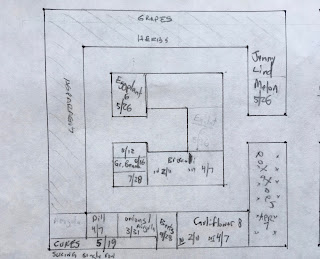
Continuing around the garden to the swingset quadrant, we have our planting plan for the 2018 season: On the left, as always, is the asparagus . It’s not nearly as productive as it once was, so this spring we will try renovating it by resetting the crowns lower in the earth and adding some lime to counteract the soil acidity from a nearby evergreen tree.  Across the top are perennial grapes and herbs — nothing to see there.  Along the right side is space for Jenny Lind melons, which is a new variety of small, green fleshed melons. This is an heirloom variety popular among the Pennsylvania Dutch, and we got the seeds on a trip to the Landis Valley Village and Farm Museum last spring. There’s also a potato patch. Along the bottom is a very small length of trellised cucumbers, which will be for slicing. We have tons of pickles from last summer, so we won’t be planting any pickling cukes at all. There’s also an assortment of dill, arugula, beets and cauliflo...

2017 Master Plan: The Workshop Quadrant

Image
Working our way around the garden, we come to the workshop quadrant. I guess we could also call this the office quadrant, since it forms the bulk my view during the day. Here’s what I’ll be gazing out at when I’m procrastinating: In the center C are celery and parsley, zucchini, cantaloupe, and a Sungold tomato plant. The Sungold, celery, and parsley are partially shaded, which should be fine. It should help slow the ultra-prolific Sungold down to a manageable harvest level, and celery and parsley will do well with some shade in the summer anyway. Across the top, as always, are our perennial grapes and herbs. In the upper portion of the right side is a succession planting of dill. This is the shadiest section of the garden, but dill is basically a weed and will do fine here. Below that is a semi-shaded section that will lie fallow for most of the season until we plant next winter’s spinach and mache in a cold frame. Across the bottom is a long trellis of peas and a r...

2016 Master Plan: The Workshop Quadrant

Image
Another section of the garden plan for spring is the quadrant near the workshop and chicken coop: The right-hand bed of this section is under a small maple tree, which we keep around because it shades the chickens nicely in the summer. It definitely limits our options in that bed, though — no full sun to be had. We've found that salad greens (spinach, arugula, mesclun lettuces, beet greens) started in a cold frame do well here, since they get sun until the tree leafs out in May. If they're reasonably sized, the shade then works to our advantage to keep them from bolting. Weedy cilantro and dill also do well here, so we amend with lots of compost and just have the herbs and greens switch places each year, and it seems to work well. Along the top are still perennial grapes and herbs, which will remain in place (give or take a few small shake-ups of the herb garden that I'm mulling over). On the left at the top is a section for potatoes, though we'll als...

From the Archives: Okra Quick Pickle

Image
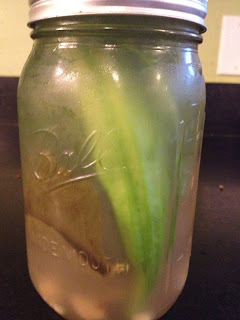
Some time over the summer, before we tore apart the kitchen, I decided to try my hand at pickling okra. I know this because I found this photo lurking in an unpublished post:  Careful forensic evidence reveals that this photo was taken on the old kitchen counter, while the kitchen was still lime green in sections. I also recall being inspired by some pickled okra we had at Loretta’s Last Call (otherwise unmemorable except for the pitchers of sweet tea) before a game at Fenway on the Fourth of July. So I imagine I threw some early okra in a jar back when the okra was just starting and we couldn’t harvest enough to eat or freeze in a decent-sized batch yet.  I also found a cryptic note to myself reading " old horseradish brine, vinegar, water, dill, peppercorn, garlic” under the photo. So, to the best of my knowledge, here’s what happened. I used a jar that had recently been emptied of its horseradish pickles and tossed in three pods of okra, in what can only ...

Autumn Greens

Image
So there's no more fuss and there's no more scenes and my garden thrives! (You should see my nectarine.) But I'm telling you the same I tell Kings and Queens don't ever ever ever mess around with my greens! ~ from Into the Woods , by Stephen Sondheim We're still slogging through our kitchen renovation , and it's sucking up a lot of time that we would ordinarily be spending on preserving the last of our summer fruits — not mention cooking delicious meals using all that garden produce. An embarrassing amount of apples, pears, and tomatoes have been fed to the chickens due to our inability to eat them in a timely fashion. One thing that's doing well and can be stored in place outside  are the cool-weather greens. Though the back half of the summer was a dry one, we had a fair amount of rain early this month to get us back on track. The moisture and the cooler temperatures mean happy greens: Cilantro, because it's related to carro...

Post-Frost Harvest

Image
After a week in which we were struggling to acclimate ourselves to the blustery cold, today we were granted a sunny, almost-warm day. It was actually pleasant to be outside again, so we wasted no time picking up the last of the leaves and cleaning up the last bits of herbs that finally died in the freezing temperatures of the past week. We also were able to bring in a surprisingly ample post-frost harvest. There's still plenty of food out there under the cover of glass, plastic, or straw, so we should be eating well for the next few months. It may well be the last nice day, but it's not the last harvest. Here's what we brought in today: This kale bouquet is just a small bit of what we have. A lot of the Russian kale got nipped back by the cold since we left it unprotected, but we fixed that today, and there are still a whole lot of leafy greens left for the winter. Our last three cabbages were unaffected by the freezing weather, but won't last forev...

Brining Kosher Dills

Image
All of the sudden, we have cucumbers. And not just one or two. Today I picked 5 1/2 pounds of the most perfect pickling cukes we've ever managed to grow.  And it just so happens that five pounds is the perfect amount for our gallon crock. Time to brine some pickles! Brined pickles are fermented, and we made our first batch last summer . Up until then we had always done a fresh pack with vinegar and canned them. Those are good, too — I do love vinegar! — but the flavors of a fermented pickle are much more complex. Fermented foods are also good for you , which make our pickle and sauerkraut crocks suddenly more trendy than Dutchy .  We liked last summer's brined batch well enough, but the seasoning wasn't our favorite. The recipe we used called for pickling spice, and the generic one we found was pretty heavy on the cinnamon. So this year I am determined to get the best spicy, kosher flavor with our brined pickles. I'm hoping for a classic here. Althou...

Dill Seed Saving

Image
Now that the holidays are over, there's more time to devote to some indoor garden tasks that have been put off. Soon that will include seed starting , but for now, there are still seeds to be separated from the dried plants that they are still stuck to. Back in December I finished that process with the black beans , and this week I moved on to dill: Over the course of the summer as the dill seed heads matured, I would pinch them off of their stems and throw them into a paper bag on the porch to dry. After sitting there for three or four months, they are definitely fully cured now: Many of the seeds already had fallen off their stems, but plenty more seedheads were still intact. I found the most efficient way to deal with shaking dill seeds loose is to pick up just a single head: Then squeeze the little branches together farther up the stem, so the seeds form a tight cluster: With your other hand, you can roll those seeds between your thumb and fing...

Frost Free and Done With Dirt

Image
We are finally finished dumping dirt into our raised beds! This is the last quadrant, and we wasted no time getting seeds into those beds once we were done filling them. This weekend marks our frost-free date, so it was time to get cracking on our planting and sowing. In the center "C" you can see our bamboo tepees (made by pulling apart an extra section of bamboo fencing we used for privacy at the Red House — glad to put them to good use!). Around each tepee are planted Cherokee Trail of Tears, an heirloom black bean that will climb those poles. In the squared off ends of the "C" are zucchini and nasturtium seeds as well. In the foreground of this bed are also mustard seedlings (too tiny to see, but they are in the rectangular section that is dark from having been watered). Our tomatillos are just off frame. Other seeds that went into the ground this weekend, now that we're pretty sure nothing will freeze: sunflowers, chamomile, and borage, plus...

The World According to Triscuit

Image
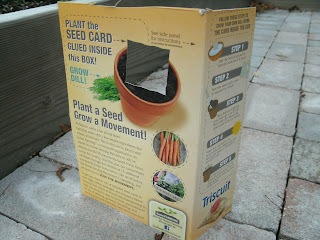
Family from Pennsylvania visited last weekend, and they came bearing gifts . In addition to two lip-smackingly delicious bags of Grandma Utz's potato chips (cooked in lard!), there was also this piece of cardboard clipped from the back of a Triscuit box: I guess in Pennsylvania, crackers come with seed cards. I have never seen this before. I'm not sure exactly what kind of movement Triscuit is seeking to foment, but I decided to give it a go. The seeds are for dill, and ours didn't germinate this summer (likely because the seeds were labeled as having been gathered in 2008 from our old garden). At this point it's probably too late to get much out of it, but I figured seeds encased in cardboard were already an experiment anyway, so we might as well get them in the ground and see what happens. Here are the directions from the box: After the soaking in Step 1, Step 2 looked like this: I have to say, I was expecting more seeds than that. I went off-book ...

Sowing the Seeds

Image
The boring part of today was pulling more weeds out of the last section of bed around the patio area (a leftover task from yesterday). The frustrating part of today was running out of compost before we could finish amending said bed, leaving a task incomplete until the tree dump opens again on Tuesday (provided we have access to a truck, that is). The great part of today? Sowing the fall veggie seeds! This is only a small section of the beds that we sowed today, but it's the most interesting one to look at because we put up the trellis and pea netting. Kirk built it for our old garden and made it take-apart-able, so it was all ready to go after a season packed up in the garage. The ladder is there because we needed some height from which to bring the sledgehammer down upon the posts, but it went back together great, after the annoyance of untangling the netting and threading the posts through it (much less arguing about that this time around, though, so hooray for marital h...