Posts

Showing posts with the label orchard

Progress in the Orchard
Image
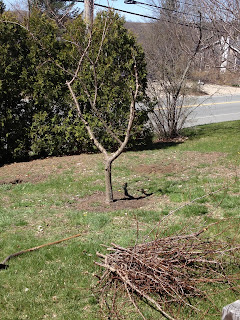
Over April vacation (so about three weekends ago now) we finally planted our new apple trees . It was a fairly long day that required first removing several of the older fruit trees that were either dead, dying, or unproductive enough to have lost their place: The biggest tree we took out was the apricot, seen above in a state of partial completion. It's a shame that this tree never actually bore more than a handful of fruit , because it was well formed, but oh well.  Once the old trees were removed, we planted the new ones in new holes, creating some more space as we went. Here's the new Winesap in the ground: All of our new plantings are cocked ever-so-slightly into the prevailing winds, which should give them a little extra purchase and hopefully eliminate the need for staking .  Once all four new trees were planted, we were left with a rather pockmarked front lawn of bare patches where old trees (and straight-up dead patches of neglected grass) we...

Our New Winesap Apple Tree

Image
I’ve been doing a lot of freelance writing lately, and one of the places I write for is Fast Growing Trees , an online nursery based in South Carolina. One perk is that they sent me a free tree, our new Winesap apple:  It’s huge — bigger than me, and much bigger than Jonas, as you can see. In the past, we’ve always gotten bare root sticks, so this tree is definitely the biggest we’ve ever gotten in the mail. It’s also packaged with its rootball intact (and in dirt), so it saved me the trouble of heeling it in .  We’re definitely  planting these trees this coming weekend. Now that the weather is supposed to be a little warmer, and we have a supply of compost from the city yard, and  we have all the trees, it’s time to break out the shovels and get these in the ground to complete the orchard renovation .  I’ll definitely be interested in seeing if the bigger tree fruits faster, or if it just means that there’s more of it to acclimate and ...

Heeling in the Trees

Image
Our new fruit trees arrived really early this year (March 18, actually). Like anything else, they come in a box: The trees are cushioned in some bubble wrap and come packed with a bunch of damp, shredded paper around their roots. As long as that stays wet, you don’t have to plant the trees right away. Good thing, too, since it promptly snowed .  I get that the ground is technically warm enough to dig in and plant these trees, but because we got them so early from the over-zealous nursery shippers, the snow — combined with our still-partially-frozen compost pile — has made it nearly impossible to plant them in a timely manner.  They can’t stay in a box in the basement forever (if you want them to survive, anyway), so I decided to heel them in while we wait for better weather and a more convenient day to plant. All you do is dig a wide, shallow hole: And then you pop in the tree at an angle so it’s mostly lying down. That protects it from the cold and...

The Orchard Renovation

Image
We've been talking about it on and off for several months now, but this week we finally committed to plans for revamping our orchard. Now that everything is bearing, we've been able to see which varieties are doing well and which leave something to be desired. But what really gave us a push in the direction of making some choices about our trees were the losses we sustained last season. Our stunted Granny Smith was completely buried by the blizzards of 2015 , and it was broken beyond saving. We also lost our best peach tree to insect damage , and the other peach and nectarine can't be far behind. Despite our efforts at sheltering it , two very harsh winters in a row kept our fig tree from ever taking off. And even though our apricot is a fine- looking  tree, we've eaten a grand total of one apricot in the past five years . So we decided to cut it down and try something else, even though the tree itself is healthy. It's no small thing to cut down a tree, whic...

The Little Apple Tree That Could

Image
You may recall that the epic Winter of 2015  brought with it a lot of damage to our plants , especially those in the perennial border and the orchard. Our small Granny Smith tree was hit particularly hard, since it was, for a time, completely buried in a full Gronk of snow : When the snow finally melted, its massive weight broke every branch on the little tree: We figured it was a total goner, but since it managed to both blossom and set fruit (!!!), we didn't remove it. The result? One perfect apple: This is the one and only Granny Smith apple harvested from that tree ever , and it was a great one: extra large, crisp, and juicy. It's a shame the tree isn't worth saving (we have some orchard redux in mind for next spring, actually), but it was nice to see it put out one prefect piece of fruit.

Peach Tree Problems

Image
About a week ago, we noticed that we had a problem in the orchard. One of these things is not like the other: It's not just the leaves of our (formerly) best peach tree that are having trouble. Check out the (former) fruit: A couple weeks ago this tree was covered with peaches just waiting to ripen up in August, but now they are shriveled down to the pits. It looks more like an almond than a peach. They all look like that. No peaches this year. So what's the problem?  Well, it's clear that the tree isn't taking up water, but we've had decent rain, and other trees are fine. As I was looking at the damage and trying to figure it out, I saw a funny bug fly by. I couldn't get a photo, but it was unforgettable. It looked like this: This image is  Image Number 1435199  at  Forestry Images , a source for forest health, natural resources and  silvi culture  images  operated by  The Bugwood Network  at the University...

Late Pruning

Image
Over the weekend we finally  were able to get out into the orchard to prune the fruit trees. This is typically a task that we take care of in February . Usually we can count on at least one not-horrible day to shape the trees up. This year, not so much. There was just so much snow that we couldn't even get to the trees.  We've finally had some melting, though, despite the fact that it has snowed every single weekend since the end of January. This time it was just a light flurry and a dusting on Saturday, but still: snowy weekend number ten . Despite the cold and pesty snow on Saturday, Sunday was warm enough for Fletch to enjoy surveying out work from the front porch: And the orchard even has bare ground in spots. Most is still in the snow, and it was enough that I had to wear boots, but at least it was passable:  Since the trees are no longer fully dormant and the buds are beginning to swell, we only did the lightest pruning possible. Pruning en...

Last Weekend of Winter

Image
It's the last weekend of winter! Next weekend we'll be beyond the equinox, and the days will be ever-so-slightly longer than the nights.  We still have snow on the ground, lots of wind, and temperatures in the 30s, but we plowed ahead with our almost-spring garden chores anyway. Here's what we did this weekend: 1. Got the chickens out on the raised bed where to prep the soil for planting greens: 2. Poked around the greenhouse tunnels to harvest the last veggies: parsnips and a couple leeks, plus a few leftover fall cabbages for the chickens (which they were very  excited about). We do still have some spinach, mache and kale left as well, but not much. 3. Improved the maple sugaring set-up by building a bigger firebox: Kirk used leftover bricks we had lying around to make a floor (so as not to ruin the bricks on our patio), then got nine cinderblocks to make the three walls of the firebox (solid side toward the fire). He also picked up some steel...

A Long Winter's Nap

Image
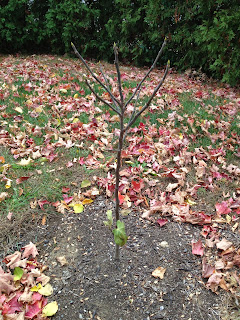
Back in the spring we planted a fig tree in the orchard. After a season of growth, it has graduated from a mere stick to a slightly more respectable baby tree:  Frost has killed off its (very few) leaves, so it's time to get our little Brown Turkey tree wrapped up for winter. Figs are not reliably hardy in our growing zone (6a), so we need to give it some protection from the cold so it doesn't die back too much over the winter. To do this, we repurposed two of the potato boxes we are no longer using to create a little fort around the tree: Kirk set one box atop the other and screwed in two extra boards to across the gap to join them together (which you can see better in the picture below). This contraption is all wood and heavy as all get-out, so it should hold its ground despite our typically blustery winter weather .  Once the boxes were in place, we filled the whole thing to the top with leaves we raked up: We have no dearth of maple leaves ...

Macouns!

Image
Our young orchard has four apple trees in it, and each one has borne a bit of fruit this year. Our best apples for eating fresh are ready right now: The bright red ones to the right are Galas ; the purplish-red ones with green undertones are Macouns .  Both are delicious, with good texture and crunch. Galas strike me as sweeter, while Macouns are somewhat more tart, with an almost spicy tang to their skins (which of course must be eaten — who peels an apple for lunch?). I love, love, love them. We only had a half dozen Macouns this year, and it's a somewhat finicky apple to grow, so we might never have huge crops. It's still worth it, though — if you can find them anywhere this fall, snatch up a big basket and eat them up while you can! Our Gala tree, as you can see, is doing quite well this year. I suspect that many of our apples ripened kind of early (it's only mid-September, after all, and we've been picking them here and there since the end of ...

The Pear Harvest

Image
While not as impressive as our massive peach harvest , our first-ever pear harvest is in the books: That's all of it — just five Anjou pears. That may not seem like much, but pear trees typically take several years before they bear fruit, so the fact that we have any pears at all yet is pretty exciting. I also pollinated these myself with a paint brush back in the spring, since our other pear tree didn't bloom this year.  The pears aren't ready to eat yet, but they seemed ready to harvest because they pulled easily off of the tree. Pears have a two-part ripening process: first you have to chill them, then you have to allow them to ripen at room temperature before you want to use them. The best information I found was from Oregon State , and according to them, Anjou pears should be chilled for a minimum of two to six weeks, then ripened at room temperature for another week to ten days.  I put ours in the crisper drawer of our fridge, and set it for high humid...

Predator Protection Trial and Error

Image
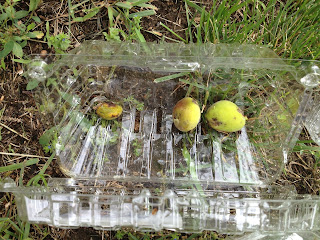
This spring we tried a few new things to keep our crops safe from animals and insects that would like to swipe more than their fair share. One promising idea was using plastic fruit containers to keep squirrels away from our ripening tree fruits. But after all of our blustery days of downpours this month, most of those containers ended up on the ground: I wouldn't mind just snapping them back in place, but the real problem is that they often brought the fruit down with them. I'm not sure if this is a flaw in the system overall, or more of an issue with apricots being kind of delicate in hanging on the tree (at least, this has been true for us — it's not the first time we've accidentally knocked one off the branch before it was ripe).  Alas, the only one we have left on the tree is this one that never made it into a container in the first place. I thought about removing the remaining containers last weekend, but decided to ride out the experiment instea...

Protecting Baby Fruit

Image
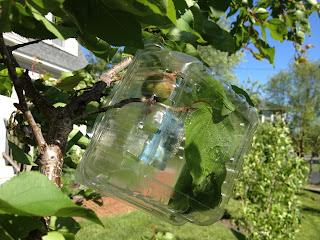
In the orchard, nine out of ten of our older trees blossomed this spring and look to be setting fruit this season. (The new fig tree  we planted at the end of April is still just a stick, albeit one with two small green buds on it.) Our apricot is the farthest along, and although it's not a bumper crop, we have a bunch of small fruits: And, as you can see, I spent some time this weekend rigging up a new anti-squirrel system on the apricot tree. I first saw this idea  over at rootsimple.com  and was able to give it a try thanks to lots of friends who saved up their plastic fruit containers over the winter. Grocery store berry boxes are perfect for this, since they are ventilated, and often snap shut. All I had to do was close them around our baby apricots (which I learned to do gently, since I knocked one off its branch by mistake). Hopefully these boxes will confound the squirrels, and we won't lose our whole harvest to them again this year.  ...

Orchard Addition

Image
Today we finally got outside to prune the fruit trees in the orchard. We had a few chances back in January, but we frittered away those warm weekend afternoons, assuming the winter was following the same snowless pattern as last winter. Ha . So this weekend we decided to get out there before our next snowfall, which is expected to start tonight. We had a pretty decent amount of melting with temps in the 40s this week, so it wasn't all that bad. The snow in most places didn't reach over the tops of my boots, and the snow on the ground actually made pruning easier, because we could really see the outline of the branches against the white background. Our trees are still pretty young, so pruning isn't a huge task, and we were done in a half hour or so. Since we finally took down the dying evergreen trees in the front yard this past fall , we now have a little more sunny space in west end of the orchard . After we put the tools away, we spent some time tromping around th...

One Small Apricot

Image
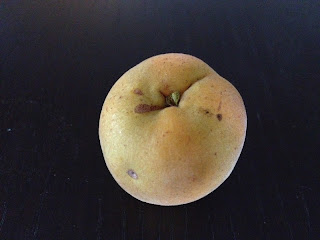
After all our work to save the apricots , the squirrels overran the orchard and got almost all of them.  All save one: This is the one small apricot that was left, the one that we swaddled in netting to try to save.  It worked, and today it shouted out bright orange on the tree, and was a little soft under pressure when we gave it a squeeze. It smelled good, too. As you can see by the pale greenish-yellow bands, it's a little underripe. We picked it anyway, though, because we were worried that it would be overripe — or worse, missing — by the time we get back from vacation next week. It's hard to split an apricot the size of a silver dollar four ways, so we sliced it up into a tart: So we're a little obsessed with the puff pastry + everything from our garden + cheese = delicious goodness formula right now. It's hard to argue with that kind of sure-fire success in the kitchen. Anyway, it's super easy. Slice up your teeny tiny apric...

Planting Out Okra

Image
I never took any photos of it, but back in the spring I started some okra ("Clemson Spineless") indoors. Okra is a heat lover, and because of that may be hit or miss here in Massachusetts, but we figured we'd give it a shot. What it has going for it is that it has a pretty short growing season, so if we get a few hot weeks, we might be ok. Our original plan called for 16 plants, but not all of our sweet potato slips made it, which left room to put in an extra row (bringing us to 20 plants). These are about six inches high right now: It's hard to imagine that this little seedling might someday be as big as the ones we saw in Williamsburg last fall. Probably not this far north, but it would be nice to get enough pods to make a gumbo and some shahi bhindi bhuna .  In other, less exciting news, we spent the better part of the day in the orchard pulling weeds, re-edging, and mulching the fruit trees with compost. This was a bummer of a task because we l...

Orchard Devastation

Image
After a week of rain, I took a stroll through the orchard to give it a check and see if the trees needed any spraying (we use a judicious bit of insecticidal soap to control aphids and a copper fungicide for rusts). And this is what I found: On the ground under our apricot tree (the one we worked so, so hard to nurture through the spring freeze ; the one that was loaded with tiny green apricots) are a pile of half-eaten apricots. This sin't just a June drop or wind damage. You can see the bite marks: One apricot is left on the tree. The rest are gone.  Gone. Eaten by squirrels . This is my assumption, at least, after some internet research revealed just how much those horrifying tree rats like apricots. And it's not just the apricots. The squirrels (or possibly birds, but this seems doubtful) ate every last nectarine, and all but two Granny Smith apples. So from four trees that were bearing their first fruit this season, we have three pieces of fru...