Posts

Happy Easter!

Image
Most of our Easter weekend was celebrated out in the garden, digging and planting and enjoying the first warm, sunny weekend of the spring. I'll share more on our progress later, but today I wanted to show off the ways in which our chickens contributed to the day: We saved a dozen of our cleanest eggs for Easter egg painting. This wasn't easy over the last couple weeks, as our chickens have been out working , scratching up the dirt in our garden beds to prepare them for planting. Kirk and I leave for work earlier than the chickens are accustomed to laying, so that often means they end up laying their morning eggs in the dirt. It's not typically a problem, unless you want really pretty eggs (which, of course, we did). The eggs above are the ones I painted. I used a white paint pen. That's not an approved food-safe method, I'm sure, but I only used an itty bit, and I lived to tell the tale, after noshing on these: Because really, the only appropr...
New Cold Frames

Image
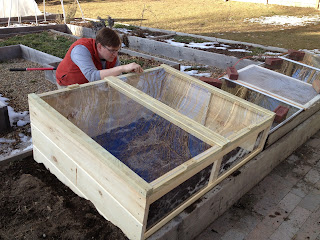
Over the weekend, Kirk built a new cold frame: Our old cold frames (one of which you can see to the right of the new one in the photo above) are full of plants from the winter and some salad-y seedlings we started at the beginning of March , so we need a few more to keep our early succession plantings going. Also, our old cold frames were built for our old garden, so they have a few weaknesses that we wanted to correct with the new ones.  First, our old cold frames are only three feet deep, which doesn't exactly cover four-foot deep beds.  Second, they are covered with a fairly random assortment of old storm windows. While these are effective, we have also lost several to the wind since they aren't attached, but rather held down by bricks. Third, they are really, really heavy. They're about eight feet long and made of 2x12 boards, so once they are a giant pain to move around.  They certainly work , but we wanted to customize the new ones for our ...

Finally, A Flower

Image
The snow hasn't completely melted from last week's final-day-of-winter storm , but look what I found in the perennial border this afternoon: That is one small Siberian squill that has opened. Lots of others have popped up in the border, and by Easter we should have lots of these friendly little blue faces to remind us that spring is here. At last. And that is all.

Working Girls

Image
If you're not interested in dirt, this might not be the blog post for you. But if you are, you might be interested in our fine-tuned chicken tractoring process. First, our fall-planted cover crop is winter rye: This is probably a much tougher cover crop than we needed in our raised beds, which don't face much of an erosion threat. I chose it mainly because we planted it pretty late and it was sure to germinate even in colder temperatures. Next year we will probably choose something with a much lighter root system so it will be easier to turn.  With the snow we've had, there are some intermediate steps about shoveling off beds to let the sun melt the rest of the snow and dry out the soil so the chickens aren't mired in mud, but in general the next step is to get the chickens on the rye grass in their portable run : Our chicken tractor is about four feet wide by eight feet long, and with four chickens in it for the day, we've discovered it take...

Forcing It

Image
Over the weekend, we put a tunnel over half of our asparagus bed: To do this, Kirk hammered a stake into the dirt first to make some guide holes for the PVC. We don't normally need to do that, but this early in the season the dirt isn't thoroughly warmed and soft. The idea here is that the heat that is strapped under the plastic will trick our asparagus into coming up earlier than it normally would. This will hopefully extend our harvest by a few weeks, and we'll still have the other half of the asparagus coming up at its natural time.  Good thing we got that in place, because we are suffering all kinds of soil setbacks, with yet another day of snow yesterday. Here's what it looks like today: So at least half of our asparagus bed is protected and warming on this, the official first day of spring. As you can see in the photo above, we had to shovel snow off of the raised bed in the foreground. We didn't do that for the whole garden, but we did t...

Onion Haircuts

Image
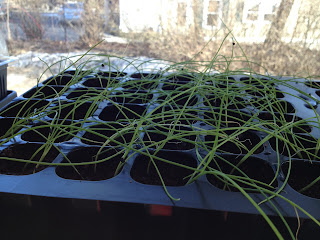
It is cold. It's been cold all weekend. Tomorrow it will snow, and we are expecting so much that the state had to reschedule the MCAS exam (our statewide, bullshit standardized test).  Major prognostication fail, Punxsutawny Phil . And so we wait. Seedlings are popping up in the cold frames and on the windowsills, and they are doing well despite the freezing temps. So well, in fact, that the leeks and onions are rather in need of a haircut: These are our red onion seedings, which we planted about six weeks ago. As you can see, they are floppy and unruly. (The leeks are far better behaved, standing upright like good little soldiers — yet another example of their superiority .) Once onions and leeks get to be over four or five inches high, you can trim them back so they aren't so top heavy. This is a finesse job, because you have to ever-so-carefully untangle and lift up individual leaves, which are still pretty delicate. After their haircut (which I perfor...

Sweet Winter Parsnips

Image
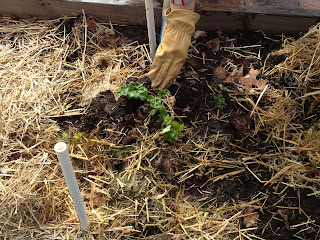
Now that the ground has softened up, we can get to our parsnips again: They are still alive and perfectly well under the straw mulch. After frost and freezing, they are much sweeter, so if you can wait — and don't mind working in the cold and chipping through some semi-frozen ground at times — it's worth it. Fall crops like kale, arugula, turnips, and parsnips create a lot of sugar when the temperatures drop because sugars keeps the plants from freezing — and therefore from dying. Think of how juice just gets slushy when you put it in the freezer, and you have an idea of how this works as a natural protection. All of that extra sugar makes these crops worth waiting for, especially if you protect them further in a cold frame, tunnel, or under mulch. Nothing from a store tastes like these: If you've never had one, parsnips taste kind of like a cross between a sweet potato (ours do anyway — that's how sweet they've gotten), but with the texture and aro...