Posts

Yellow Jacket Attack!

Image
Last weekend I was watering the garden ( the drought continues ) when I noticed a few small bees flying about. That’s not terribly unusual near the fruit, and since I am fairly comfortable around bees now , I didn’t pay it much mind.   Big mistake. It turns out that there’s a nest of yellow jackets in the blueberry bed, which you can see above. I watered the blueberries first, then s tepped over the nest (an error I realize now, but obviously not at the time) to water the raspberries.  And that’s when the yellow jackets decided to attack. I got stung and backed away, but one got up under my shirt. And kept stinging.  I did manage to get inside the house before tearing my shirt off (you’re welcome, neighbors!), and pretty much dashed upstairs for immediate Benadryl.  Meanwhile, Kirk shook out my shirt inside, which released that angry yellow jacket and terrified the children. He managed to shoo it out the door without further incide...

The Himrod Harvest

Image
We’re missing a lot of big-ticket fruits and veggies in the garden this year: no peaches , nectarines or pears, thanks to pests last year and a badly-timed cold snap in late February. No cucumbers or green beans, thanks to a voracious (but since removed) groundhog. And everything is suffering from the drought, which is still a major player in the 2016 garden.  Despite the issues, our grapes are doing relatively well, since they tend to prefer drier conditions (not this  dry, of course, but they’re holding up). We have two vines each of four different varieties, and Himrod is the first to ripen:   Himrod is a white grape bred to do well in the Fingerlakes region, so it makes sense for our northern garden. It’s sweet with a musky-tart skin, and it’s a variety made for eating, not winemaking . Ours are seedless. Because they ripen so early — and because all  our grapes are green at this point — we haven’t timed the harvest properly in the past, ...

Heirloom Tomato Tasting

Image
It’s been slow going for our tomato plants this year. The cold, cloudy spring and dry summer have basically put our plants on pause. Still, they are growing — albeit at a glacial pace — and producing. They’re just several weeks behind schedule. When we lost most of our vining tomato seedlings, we replaced them with transplants. To cheer ourselves up, we took advantage of the opportunity to sample several new-to-us varieties. Here’s our first basket: Not pictured: our Amish paste and Paisano tomatoes, which are all still green on the vine. We also planted a new variety called “Mexico,” but the one reddish one wasn’t quite ready to be picked yet. Below is one of everything except Early Girl (the small red one in the 10 o’clock position above), which is a perfectly okay tomato if you like the grocery store kind. Above we have the more interesting ones for tasting. Top row, from the left: Black Krim, Rose, Red Brandywine. Bottom row: Yellow Pear, Sungold, Green Zebra....

Edible Souvenirs

Image
Back in mid-July we went on vacation. (With such a big garden and several animals, the likelihood of me ever making that statement again seems slim — we really should save our vacationing for the off-season.) We drove all over Arizona, Nevada, and Utah, and it was great.  When we travel, we’re not super into souvenirs, though we do tend to pick up some edible ones. This time we bought prickly pear syrup with the intention of making our own prickly pear ice cream (we had some in Prescott, AZ, and it was really good!) and some Southwesternized gin and tonic concoctions. But alas! We forgot about the liquid rule and it got confiscated at the airport ( very  nicely,  I should add, considering I also left my phone in my pocket and we were generally completely brain dead after 12 days in the desert). What did make it home was a package of stoneground blue corn meal and Hopi tea that we bought at the  Hopi Cultural Center  from the couple who harvested and d...

Things Are Looking Up

Image
From our very cold, slow-to-start spring and  current drought  to the loss of pollinators and groundhog raids , it’s been a really rough go of it this year. Though we were beginning to despair of ever having food to eat this summer, a bit of rain this morning and some successes have us feeling more optimistic. Here’s what’s going right this week:   Remember the beet leafminers that nearly defoliated all of our beets and chard? Thanks to a regimen of removing affected leaves and twice-per-week applications of neem oil, both beets (above) and the Swiss chard (below) have bounced back quite nicely, and we’re now able to harvest both at will. The cold, cloudy winter and spring made it hard to get our tomato seedlings started indoors, and many didn’t make it when transplanted because they were so puny. Then came the drought, and though we have some blossom-end rot due to those conditions, we also have plenty of tomatoes headed our way. They’re a couple weeks...

Summertime Drought

Image
According to the U. S. Drought Monitor, our corner of Massachusetts is officially in a severe drought .  This is a classic application of Murphy’s Law, since we actually planted grass in the front yard this spring. Those efforts were doing reasonably well a few months ago, but we haven’t had a good rain in what feel like forever, and now things look like this: In case you were wondering about our garden irrigation habits, I aim to make sure that the productive food areas get an inch of rain per week, while ornamentals, herbs, and the grapes get a half inch. I keep an eye on the rain gauge and make up the difference with water from the rain barrels or the hose.  Things are so dire right now, though, that I will have to start watering the flowers more regularly as well. To wit, the hydrangea I planted last summer: And that’s in a shady  spot. Did I mention that we are also on something like Day 5 or 6 or a heat wave? (Well, Boston is. Newburyport gets th...

Broken Bees

Image
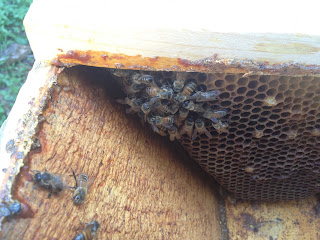
When we got our bees back in April , we were hopeful that they would get a nice head start this year since there was still a good deal of drawn comb from last fall’s hive. But there were problems from the get-go, and it seems that this colony has also failed.  When we went check on the queen to make sure she was out of her cage, we couldn’t find her, and there was no evidence of her laying. We called the person who sold us the bees right away knowing that if the queen died or failed we would need another right away. He was not sympathetic.  The whole thing was incredibly frustrating. You hear a lot about beekeepers being excited to teach other people about keeping hives to try to help protect honeybees, blah blah blah. We had quite the opposite experience, dealing with someone who clearly thought we were stupid and should just wait it out because we didn’t know what the queen looked like. Long story short: we were right, our queen failed, and then the bees di...