Posts

Showing posts with the label Cherokee Trail of Tears beans

2016 Master Plan: The Workshop Quadrant

Image
Another section of the garden plan for spring is the quadrant near the workshop and chicken coop: The right-hand bed of this section is under a small maple tree, which we keep around because it shades the chickens nicely in the summer. It definitely limits our options in that bed, though — no full sun to be had. We've found that salad greens (spinach, arugula, mesclun lettuces, beet greens) started in a cold frame do well here, since they get sun until the tree leafs out in May. If they're reasonably sized, the shade then works to our advantage to keep them from bolting. Weedy cilantro and dill also do well here, so we amend with lots of compost and just have the herbs and greens switch places each year, and it seems to work well. Along the top are still perennial grapes and herbs, which will remain in place (give or take a few small shake-ups of the herb garden that I'm mulling over). On the left at the top is a section for potatoes, though we'll als...

2016 Master Plan: The Swingset Quadrant

Image
Continuing with the garden plans for the spring, here is the swingset quadrant diagram: The full left side is the perennial asparagus bed, so no changes there. Ditto for the top, which is still grapes in the back and perennial herbs in the front. I may end up moving around some of the herbs once they come up in the spring and I see what's there. Anyway, the upper portion of the right side is mostly head lettuce, which will be shaded by a trellis of pickling cucumbers (on the long side) and slicing cucumbers (on the short side). The shade should help keep the lettuces from bolting in the summer heat, especially since the trellises are oriented to block out afternoon sun. The lower half has pole beans along the right side, which will vine their way up poles that arch over the center path. We did this in the past closer to the house, and it worked well to form a shady arbor to support all the beans — like the bean house , but over the path instead. The rest of the bed i...

One Last Summer Harvest

Image
We often don’t have a killing frost here the first couple times it’s predicted, protected as we are by the ocean, which acts as a big heat source and keeps our temperatures slightly warmer in the winter and cooler in the summer. In the game of protecting tender plants, those few degrees in either direction are crucial. This year, though, there was no flirting with 33 degree nights. The temperature dropped right down to 30 last night, and that did in the last of the summer fruits. We prepared to protect our leafy greens , and yesterday I also went through the garden to pick anything that looked big enough to be worth saving:  As a general rule of thumb, fruits will not survive a frost, but root vegetables will be just fine until a hard freeze, thanks to the insulating power of the earth. Leafy vegetables are a toss up: Basil gave up long ago and green beans are out, but arugula, cabbage, and kale are fine. Broccoli is also usually pretty tough, but we were planning on ...

Falling Into Fall

Image
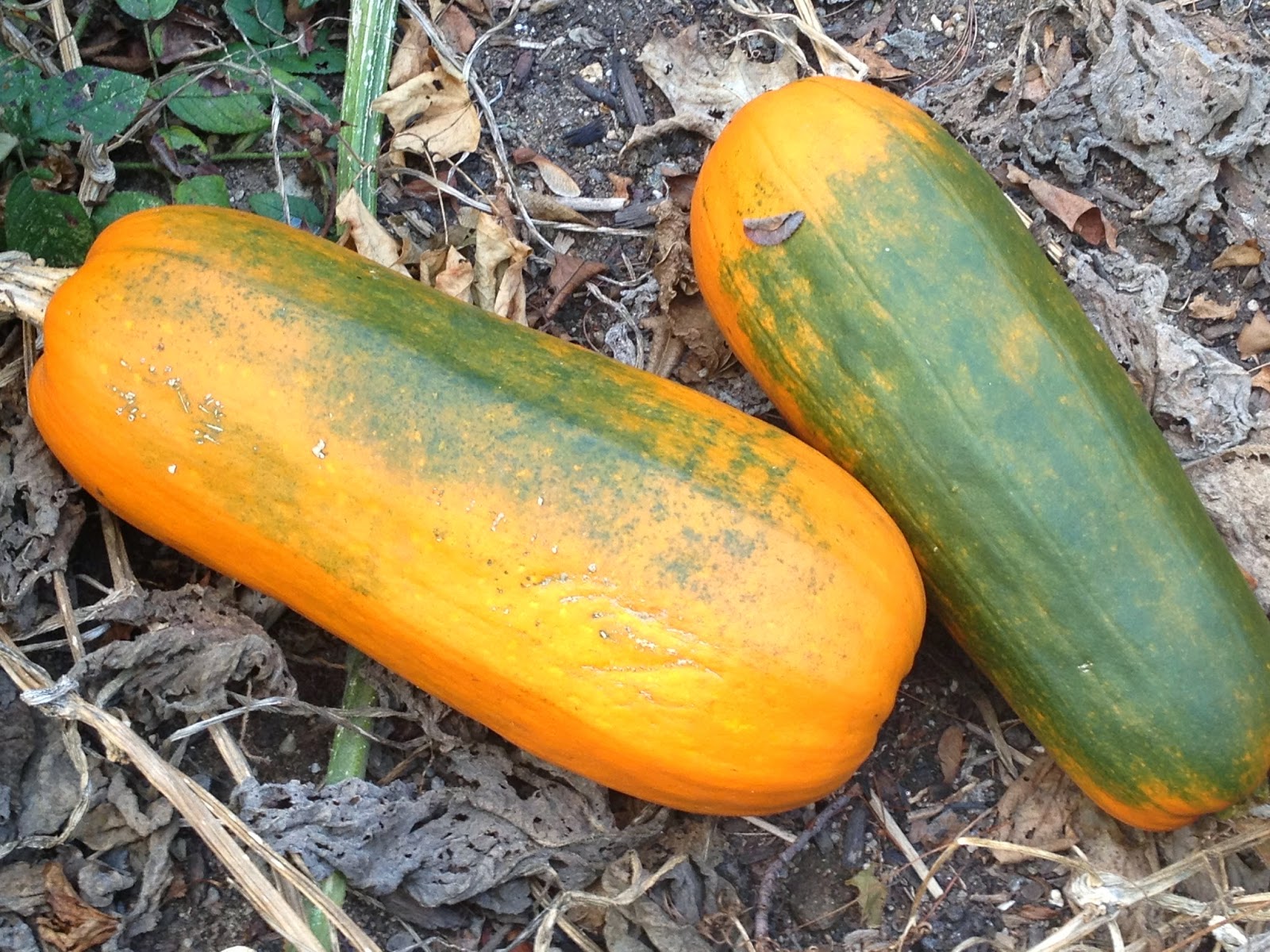
The equinox is just around the corner, and soon we will be heading toward the dark days. The chickens are molting rather then laying (Sally remaining our reliable exception, of course). The temperatures (especially in the early morning hours) are cooler, and though we are still several weeks away from frost, the garden has shifted from the lush greens and vibrant reds of high summer to the mellow golds and dusky purples of autumn. I am always sad to see summer go, but there are compensations. Our very small pumpkin patch has produced a good number of heirloom Long Pie pumpkins this year. The vines have died back almost completely, and the fruits are curing in the waning hours of sunlight. Hopefully they'll have time to ripen to orange before frost. Our Cherokee Trail of Tears beans are drying on the vines. They are a papery purple now, and I have been slowly picking them so we can shell them before frost. No rush on this project, though. They dry just as well on the ...

Welcome Back, Gardener

Image
Going to Central America and leaving the garden behind for a month in high summer is a bit like living out one of those traveling at the speed of light theoretical paradox deals. You know, like the astronaut who gets sent to Saturn and it feels to her like it only took a couple hours to get there and back, but when she returns, her grandkids are her own age or something. Well, it's kind of like that. When I left, I was coaxing some fall seedlings along. Cilantro, radishes, carrots, kale, and beets were newborns. The zinnias were only just beginning to bloom, and everything was tucked into neatly into its assigned, geometrically ordered quadrangular patch.  And here's what it looks like now: The fall babies are stout and strong, and need thinning. The zinnias are in full bloom, and now stand about eye-high in the cutting border. As for our obedient and orderly July garden, let's take an aerial view tour for old time's sake : The...

The Bean House Club

Image
Several weeks ago, I overheard the kids talking about what kind of rules they should make for something called "The Bean House Club." I'm not sure what they decided on, or how often they played there, but here are some photos of the bean house in high summer: As you can see, the pole beans (mostly Cherokee Trail of Tears , but also some Kentucky Wonder) had no trouble creating the shady bower we imagined when we put up the PVC frames back in June . You can also see that the pumpkins and squash planted around the outside of the bean house more than filled in their allotted space as well. In fact, we had a few pumpkin vines start climbing the bean house frame. The photo above is a side view. The doorway is to the left — imagine the entrance to an igloo, and that's kind of the shape. There is also ferny, floppy asparagus to the left, and this turned out to be a very jungle-like quadrant this year. I think you had to be a member of the club to know just ...

The Bean House

Image
Some new seasonal architecture for the garden: Last year we used bamboo poles to make tripods  to support our pole beans. Around the tripods grew our squash and pumpkins, but there wasn't a whole lot of room left for those vines.  So this year we thought we'd try to maximize the space for the vining squashes by sending the beans up and over the gravel path. As you can see in the photo above, the poles are right around the center (or "keyhole") of our C-shaped bed in the swingset quadrant. Each pole has several beans planted in a circle around it, and after they come up, we'll thin it to just three plants per pole. Hopefully the vines will fill in and grow up to form a shady place for the kids to sit in when they are tired of the swingset.  The how-to on this is pretty simple. We used 10 foot sections of 1/2 inch PVC pipe (which we already own as part of our winter greenhouse setup ). They are held together at the peak with PVC pipe joiners :...

It All Amounts to ...

Image
... a hill of beans. Or, more precisely, a half gallon of beans. (Ok, so we ate half a jar already in various chilis. But the total harvest was about two quart-sized mason jars.) I finally finished shelling our Cherokee Trail of Tears beans this weekend.  We harvested the last of them back in early October, before our first frost. When we did that, we picked any remaining pods (ripe and not-so). They were drying out on the screened-in porch ever since. Gradually we've picked away at that pile, shelling a bowl at a time in front of the TV, on rainy days or during dark evenings.  It definitely makes sense to let them dry in the pods. They are much easier to shell that way, and then you save a step on having to dry the beans after shelling. It does take some skill, though, to deal with the brittle pods. I kind of crush it in one hand until it splits, but keep that hand cupped around it as I pull the two shell sections apart with my other hand. This helps keep the ...

Cherokee Trail of Tears Beans

Image
The pole beans we grew this year are Cherokee Trail of Tears, an heirloom variety of black bean that were, according to oral history, carried from North Carolina to Oklahoma during the forced relocation of the Cherokee tribe . They got off to a slow start for us early in the summer, but throughout August and September they've been producing really well: As they ripen, the bean pods turn from green to this gorgeous purple color. This makes them much easier to find among the vines than regular green beans! When I first opened a pod, I was surprised to see that the beans are actually purple instead of black, like tiny eggplants: As they dry, the color darkens up a bit. We spread the pods out on the porch counter to air dry, which makes them much easier to shell. Once you sit around and shell a bunch of them, they pretty much look like a bowl full of shiny black beans: The beans above are not the whole harvest. There are still some drying, still plenty on ...