Posts

Showing posts with the label Costa Rica

Herbal Apothecary: Costa Rican Sun Balm

Image
It’s hard to believe that our trip to Costa Rica was almost two years ago, and even harder to believe that it took me this long to finally make the lip balm I was planning with the ingredients I bought at the cacao plantation we visited .  Though, to be fair, I only just ran out of the lip balm I made over three years ago . Truly, a little goes a long way. Anyway, today I finally gathered my Costa Rican ingredients: achiote and cocoa butter:   This cocoa butter was made by hand by our tour guide Priscilla , so it's unrefined. It still smells good and chocolatey, and the color is tan rather than white: Since cocoa butter is solid at room temperature, I dropped the whole container into some boiling water to melt it: While that was melting, I gathered the rest of my ingredients: beeswax and coconut oil . The proportions here are 1 part beeswax, 2 parts coconut oil, and 2 parts cocoa butter: It all gets melted together and stirred over ve...

Achiote and Anona

Image
While sorting through some photos from Costa Rica, I realized I never shared the last interesting tidbits from our trip to the Bribrí cacao farm  on the Caribbean coast. Before we got into the nitty-gritty of making chocolate, we toured the farm to check out some of the other useful plants that grow there.  First, our guide Priscilla picked a ripe achiote  and broke it open to show us the seeds inside: In English this is known as annatto. When the achiote  skin is leathery and brown, it means that the seeds inside are ready to use. The bright red seeds can be dried and crushed to make a reddish-orange spice that is used in many Mexican and Central America recipes. Priscilla explained that the Bribrí people also used it for painting their skin bright red, for keeping cuts clean, and for soothing a sunburn. Tiegan was happy to give that last use a try, as she had just the day before gotten the worst sunburn of her life: I bought some ground achiote...

How to Make Chocolate, Part 2

Image
The last time we talked about chocolate , we saw how it grows, and how the Bribrí people of Costa Rica ferment and dry the beans in the traditional way. The next step is the roasting of the cocoa beans: This, according to our host, Priscilla, is done in very small batches — only three kilos at a time. The beans are placed into a pot over open flame and stirred while they roast to make sure that they are evenly heated and none end up burnt. They start out a reddish brown color, but they are dark brown by the time they are finished: At this point, they smell just like what we are used to — good and chocolatey. Once the beans are cool, they are placed in a burlap sack and crushed with a heavy pole. When poured out of the sack and back into a bowl, the chaffy bits encasing the bean blow away, leaving behind whole and crushed cocoa beans: The crushed beans are then run through a mill, which removes any remaining chaff and grinds them into a paste: The paste c...

How to Make Chocolate, Part 1

Image
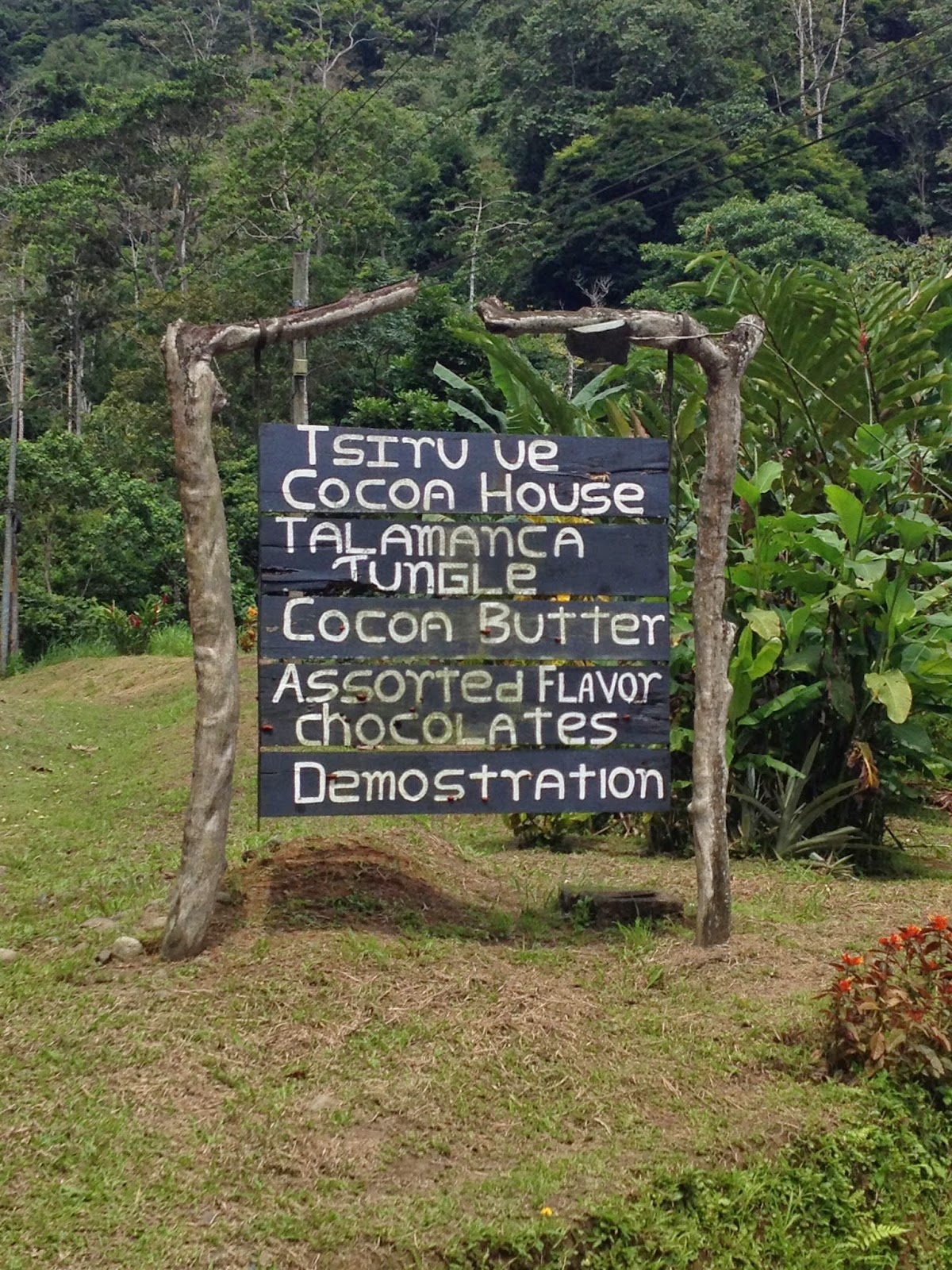
While staying in the small town of Cahuita on the Caribbean coast of Costa Rica, I visited a small cacao farm just to the southwest of Puerto Viejo. This farm is called the Jungles of Talamanca, and it's owned and operated by a Bribrí family who offers tours and tastings of the chocolate they make by hand. Blink and you could miss the sign: The Bribrí is an indigenous group of people who have lived along the Caribbean coast of Costa Rica since pre-Columbian times. They live on reservation lands, although many also have inter-married into the local community. Their language is now taught in all schools within the reservation's limits, along with Spanish and English. According to our host, Priscilla, one reason that the Bribrí culture has remained largely intact is that when Spanish missionaries arrived to convert them, the missionaries decided that many Bribrí purification rituals were similar to those in the Old Testament. Although the missionaries stressed that purif...

The Best Fruit You've Never Eaten

Image
One thing we've loved about being in Costa Rica is all the tropical produce that we get to eat. We've enjoyed incredibly ripe, sweet watermelon and mangoes, and have had no trouble picking out a ripe avocado — they're all ripe. The pineapple is unbelievable — when it doesn't have to travel 3,000 miles, it's juicy and aromatic in a way that we just don't get in Massachsuetts. But our favorite fruit of all? The mamón chino : This is a tropical tree fruit with no real English translation. It's like a small, delicious treat from another planet. It's red spiny-ness is only the beginning. Once you dig in a thumbnail and peel back the skin, you see this: The picture doesn't quite do it justice, but it's like a smooth, alien eyeball. When you bite into one, the texture is like that of a peeled grape, but the fruit is juicier and sweeter, with no acidity. There's also an almond-like pit inside: Your job is to ...

How to Make Coffee, Part 3: The Cup

Image
After learning how coffee grows and how it is processed , the final leg of our tour of Hacienda Real  revealed how the coffee is roasted and readied to drink. Because Hacienda Real ships only unroasted beans to their buyers, their roasting operation is quite small. They only roast for local buyers like area hotels and restaurants — and to package and sell in their factory store. The roaster is a mid-century antique from Germany: This is probably the coolest-looking machine anywhere, ever. Alas, we did not get to see it in action, but to use it, workers climb the steps to dump the beans into the copper hopper. From there the beans pass through chute into the black drum, where they are tumbled around while heated, not unlike popcorn. When roasted to the desired color, the beans are then released to the pan where that silver bar spins the beans around to cool them. When that is finished, they fall down the short, silver chute into a bag. There are no computers on th...

How to Make Coffee, Part 2: The Factory

Image
After touring the fields and gardens of the coffee plantation at Hacienda Real, we walked over to the on-site factory where they process the beans.  Workers use baskets to hold the red, ripe coffee berries as they pick them. When they have a full basket, they head back to the factory and pour their baskets into the square metal box for measuring (an exact number of kilos). When it's full, the box of coffee berries is then dumped into the hopper: The berries pass through the hopper into a large holding bin, where they are rinsed with clean water piped in from the river. The rinsing is mostly for cooling the berries off from their time in the warm sun: From the hopper, the berries pass through this giant food mill to remove the first two skins and layers of pulp. If you look at the orange square in the middle, you can see the spiral-shaped auger (which you will recognize if you use a food mill for any tomato processing or applesauce making ). The pulp and skins...