Posts

Showing posts with the label parsnips

Brr...

Image
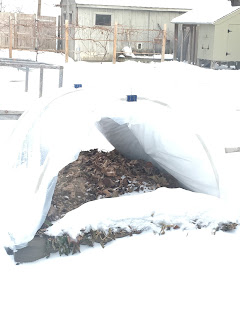
The big story of the end of the year is the weather; specifically, the frigid temperatures that we’ve been forced to endure for the past several days. It’s been a struggle to get out of the single digits this weekend, and the cold snap is expected to last well into the New Year. By the time it warms up again, we’re likely to have ridden out 12 days in which the highs didn’t crack 20 degrees. This arctic blast means that our carrots and parsnips are well and truly frozen underground, and all of our greens are probably done for. Even kale will struggle under cover with that type of deep freeze, though it will begin to put out new leaves as soon as it warms up a bit. I’m not sure about the leeks, but the underground bulb will probably be fine once we are able to dig them up again. In the meantime, we're staying inside as much as possible!

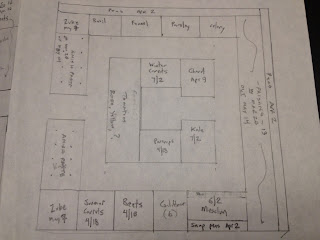
2017 Master Plan: The Driveway Quadrant

Image
It’s that time of year again! We’ve been a little slower than usual to get the garden plan done this winter, as we’ve been driven to distraction by current events . Still, we finally finished that work today, and leek and onion seeds have already been started. Here’s hoping that the spring will bring the goodness and light of things growing and being nurtured in your corner of the world, too. Starting in the center C, you can see dots that indicate the spots where PVC pipes will be inserted for pole beans. We’re doing the bean house again here! Around the outside is a traditional companion planting of squash and pumpkins.  Across the top of the top bed is a long row of trellises cucumbers, both pickling and slicing. We’re going all in on these this year, since last summer’s drought left us with just one  cucumber for the whole season. Behind the cucumbers will be bell peppers, hot peppers, eggplant, head lettuce, and a few succession plantings of cilantro. ...

2016 Master Plan: The Driveway Quadrant

Image
The final quadrant of our planning for the upcoming growing season is the one nearest to the driveway: Along the top is a long trellis of peas, which is on the northern end of the bed so as not to shade the zucchini and annual herbs grown in the rest of the area (basil, fennel, parsley, and celery). To the right is another 27-foot trellis of peas. We don't usually orient them this way, but since it's to the east, we are confident that the Roma tomatoes behind it will get enough afternoon sun. The peas will also be gone by July, well before we expect to harvest any tomatoes anyway. Along the bottom are crops that can handle a bit of shade from the house as fall comes. Here we have another zucchini plant, summer carrots, beets, mesclun lettuce for the summer, and a short trellis of snap peas. We also have a block marked out for something new: cauliflower. I have never been a big fan, though my distaste has probably always had more to do with the whiteness of the wh...

Piles of Parsnips

Image
In addition to all the exciting creature additions this week, we also had a major harvest of parsnips: That five-gallon bucket is overflowing, and that's just half of the harvest.  Parsnips are at their best after a couple frosts to sweeten them up, and normally we keep them heavily mulched to dig out a bunch on warm winter day. That way we can have them throughout the winter without worrying about storing them inside.  We may have to rethink that plan after  this winter , though. For two months we couldn't get anywhere near them, as they were buried under six feet of snow. Perhaps this fall we'll try processing some to freeze in a puree or store them whole in a bucket of sand in the basement so that we have access to some blizzard food. For now, we're stuck with a whole winter's worth of parsnips (which, as Murphy's Law would have it, did better than ever before). We gave some away to our friendly neighborhood beekeepers and got star...

Sunday Dinner: Roast Beef

Image
Last night we had a pretty excellent Sunday supper. It was all delicious, but can you spot the star ingredient? Our colorful wintertime plate included herbed mashed potatoes and gravy, a really tasty rosemary roast dressed with horseradish, roasted carrots and parsnips, and (drumroll) Brussels sprouts! If you have been following this blog for some time, you know that growing Brussels sprouts has been an ongoing challenge for us. This year we finally had some worth harvesting, and last night we enjoyed them sautéed with just a touch of maple syrup. They were sweet and tender after spending a good month out in the cold, and I will give a full accounting of the successes and failures of the Brussels sprout crop later this week. For dessert we opened up the spiced peaches that Jonas made back in the summer: True to their name, they were very, very spicy. Luckily, these were very ripe and very sweet peaches that could stand up to the powerful amount of cinnamon we ...

Signs of Spring

Image
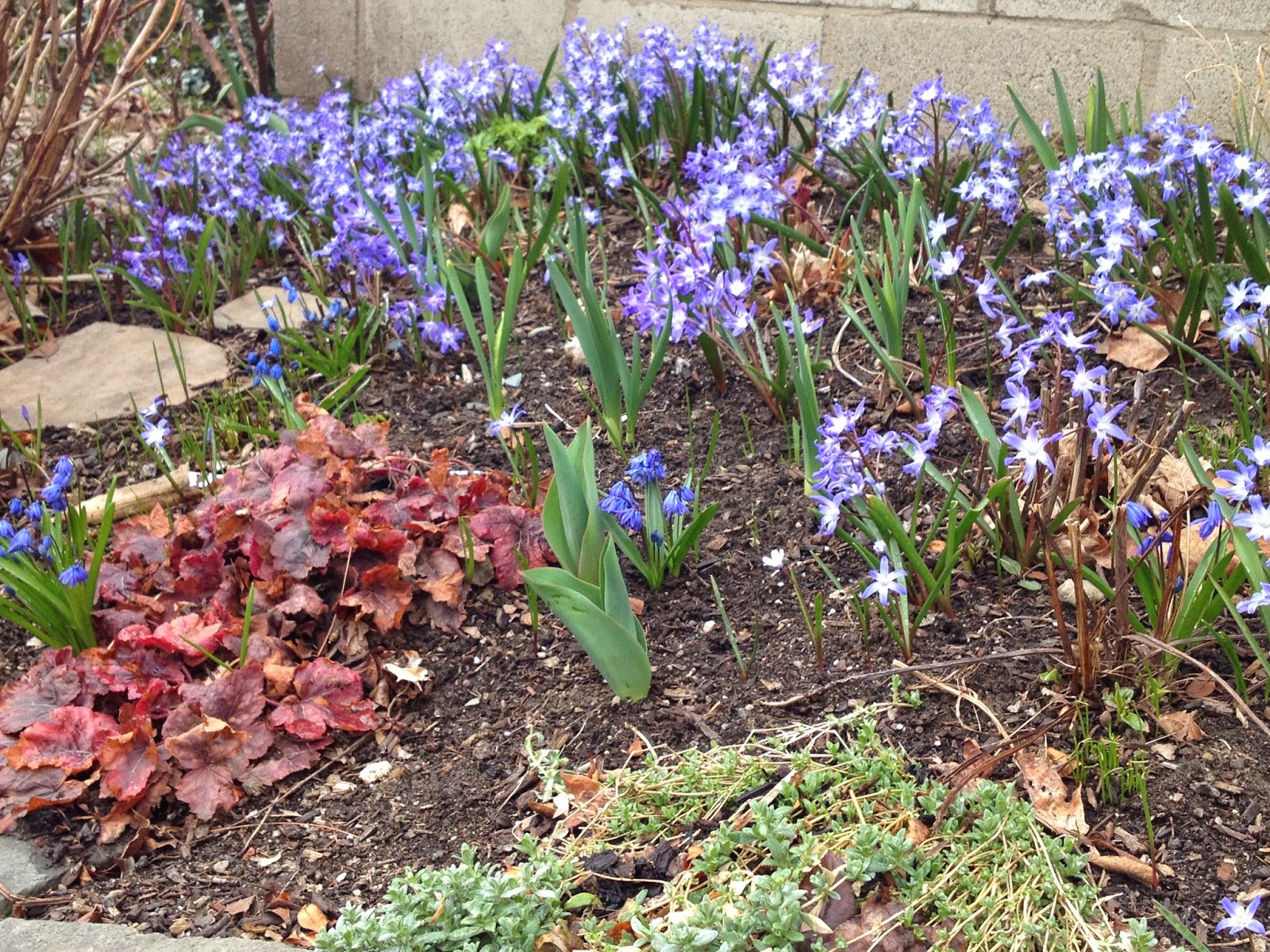
We've been on a springtime weather roller coaster here the past several days, bouncing from balmy to brisk and back again. It was another big weekend in the garden, with lots of bed prep and planting (leeks, onions, carrots, parsnips, radishes, Brussels sprouts, Swiss chard, and potatoes). My hamstrings and hands are still sore, but we got a lot done. It would be a shame, though, to focus only on the to-do list without enjoying all the little changes that spring brings to the garden. Here's what's blooming: Bulbs are up in the perennial border, and these blue glory-of-the-snow get better each year. We inherited them and they have naturalized nicely. There are also some darker blue Siberian squill, which are just starting to come up. We removed the spills from the sugar maple now that sugaring season is done. The wound should heal over by autumn. More blue! These sky blue muscari bulbs are in the cutting bed, but I never actually cut them down.  ...

Last Weekend of Winter

Image
It's the last weekend of winter! Next weekend we'll be beyond the equinox, and the days will be ever-so-slightly longer than the nights.  We still have snow on the ground, lots of wind, and temperatures in the 30s, but we plowed ahead with our almost-spring garden chores anyway. Here's what we did this weekend: 1. Got the chickens out on the raised bed where to prep the soil for planting greens: 2. Poked around the greenhouse tunnels to harvest the last veggies: parsnips and a couple leeks, plus a few leftover fall cabbages for the chickens (which they were very  excited about). We do still have some spinach, mache and kale left as well, but not much. 3. Improved the maple sugaring set-up by building a bigger firebox: Kirk used leftover bricks we had lying around to make a floor (so as not to ruin the bricks on our patio), then got nine cinderblocks to make the three walls of the firebox (solid side toward the fire). He also picked up some steel...

Soup, There It Is!

Image
Ok, so the kids weren't all that psyched about tonight's dinner until I reminded them of this: Justin Timberlake - Cup O Soup by tony0413 Then they got on board. Anyway, you shouldn't need any convincing to be excited about this dinner: Kirk made a chicken barley soup and some sage rolls, and it was all delicious — perfect for an icy-cold day between snowstorms. Chicken Barley Soup 3 chicken breasts 2 stalks of celery 3 leeks 6 small parsnips 1 Tbs. peppercorns 1 lemon dried herbs 1-2 Tbs. olive oil 2 large turnips 3/4 cup barley 8-10 sundried tomatoes  1/2 cup frozen peas salt and pepper to taste To make the quick stock, fill a large stockpot with 3 quarts of water, 3 chicken breasts, plus a stalk of celery, 2 leeks (cut into large chunks), 6 small parsnips, 1 Tbs. crushed peppercorns, 1/2 a lemon, and a handful of dried herbs of your choice (we used sage and thyme).  Bring to a boil, then simmer for 1 hour....

Live and Learn, Part 2: Too-Tall Tunnels

Image
Although for the most part this fall had been mild and calm, that all changed last weekend with ( surprise! ) a gusty wind storm that tore up one of our greenhouse tunnels: This one houses our leeks (to the left), plus some root veg, bok choy, arugula, and cabbages. Well, it used to. Now it's the home of bok choy popscicles: The picture doesn't quite get across that during the rapid temperature drop into the teens, the bok choy was frozen absolutely solid. I could have broken pieces off with a snap, like that experiment where a scientist dips a rubber ball in liquid nitrogen and then smashes it on the ground. So much for the stir fry we were planning on. The leek leaves are similarly frozen, but since that's not the part we eat, it's not a problem. Underground, the fat white bulbs are still happy. Kirk was able to fix this just to cover the leek half up before the big rain storms hit last night. The leeks would likely survive the winter uncover...

Groundhog Damage

Image
Earlier this summer, I blamed a baby skunk (and its presumed nearby family) for destroying our broccoli and Brussels sprouts. Despite putting a fence around our brassica bed, we were still losing branches off of those crops: But not, as you can clearly see in the photo above, any nibbles off the cabbages. What a strange creature! It takes all the trouble to get in around the fencing, and nibbles on less-than-ideal remnants of broccoli and Brussels sprouts while completely ignoring big, beautiful cabbages than are a foot away. Well, up until earlier this week, that is. That's when, during a stroll to the compost pile, I discovered that A) the skunk had finally sampled a bit of a cabbage, and B) it's not a skunk at all, but a groundhog! He saw me and ran, giving away his point of entry in the process. So clearly there's a major weakness in our chicken wire fencing around the "C." The "doorway" to the keyhole just has loose fenc...

Onion Haircuts

Image
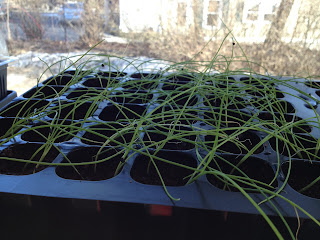
It is cold. It's been cold all weekend. Tomorrow it will snow, and we are expecting so much that the state had to reschedule the MCAS exam (our statewide, bullshit standardized test).  Major prognostication fail, Punxsutawny Phil . And so we wait. Seedlings are popping up in the cold frames and on the windowsills, and they are doing well despite the freezing temps. So well, in fact, that the leeks and onions are rather in need of a haircut: These are our red onion seedings, which we planted about six weeks ago. As you can see, they are floppy and unruly. (The leeks are far better behaved, standing upright like good little soldiers — yet another example of their superiority .) Once onions and leeks get to be over four or five inches high, you can trim them back so they aren't so top heavy. This is a finesse job, because you have to ever-so-carefully untangle and lift up individual leaves, which are still pretty delicate. After their haircut (which I perfor...

Sweet Winter Parsnips

Image
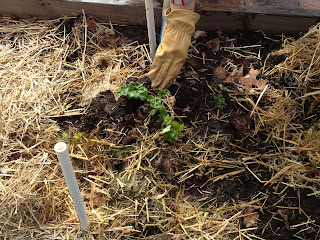
Now that the ground has softened up, we can get to our parsnips again: They are still alive and perfectly well under the straw mulch. After frost and freezing, they are much sweeter, so if you can wait — and don't mind working in the cold and chipping through some semi-frozen ground at times — it's worth it. Fall crops like kale, arugula, turnips, and parsnips create a lot of sugar when the temperatures drop because sugars keeps the plants from freezing — and therefore from dying. Think of how juice just gets slushy when you put it in the freezer, and you have an idea of how this works as a natural protection. All of that extra sugar makes these crops worth waiting for, especially if you protect them further in a cold frame, tunnel, or under mulch. Nothing from a store tastes like these: If you've never had one, parsnips taste kind of like a cross between a sweet potato (ours do anyway — that's how sweet they've gotten), but with the texture and aro...

This Week's Planting

Image
This week we planted three vegetables: asparagus, parsnips, and corn. Our asparagus crowns (Jersey Supreme) came in the mail from Johnny's in the middle of the week, and we were lucky that Kirk was able to get an afternoon off so we could get them in the ground before the rains came today. Asparagus in an investment in the future. We won't be able to harvest any of it this year, and only a little bit next year, if  the stalks that come up are big enough. But the third year, we should be in business with weeks of asparagus in the spring and early summer. We planted 48 roots like the ones above. We planted ours about 14 inches part in holes 6 to 8 inches deep. Kirk would dig the holes and drop the root in; I'd follow behind with a big handful of compost for each and then lightly cover the holes with loose earth. After they were all in the ground, they got a watering. All that's left to do is add lots of compost each season and wait a year for some asparagus...