Posts

Showing posts with the label mustard seed

Brined Pickles: A Follow-Up Report
Image
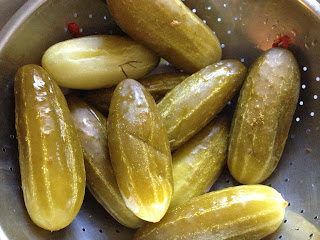
It occurs to me that I never wrote about how our brined kosher dills turned out. Since I started those back in mid-July, we have made a bunch more fermented pickles. First, a look at how the original batch turned out: This is what they look like after three weeks of fermenting in the crock. I pulled them out of the crock and gave them a quick rinse, then strained the brine into a pot to boil it.  (Now, I know that boiling it kills all the good bacteria from the fermentation process, making this no longer a "living food" and blah blah blah . But we don't have enough room in our refrigerator for 10 gallons of pickles chilling in their living brine. Gotta can them, and that means boiling it all up. It doesn't really change the flavor, which is my main purpose here.) Anyway, after boiling the strained brine, you pack the pickles in hot jars, pour the brine over them, and process in a boiling water bath canner for 15 minutes.  As you can see, t...

Too Many Seedlings!

Image
Last weekend Kirk sowed the seeds for fall broccoli and cabbage. A day later, this is what we woke up to: After Kirk assured me he didn't just broadcast the seeds all over the bed, we figured out that they were probably mustard seedlings. The birds got a lot of the seed heads before we harvested it , so we figured the house finches probably dropped seeds in these beds as they flew away.  But then we noticed that there were hardly any seedlings popping up in the newly-cleared bed where the mustard plants used to be. That didn't add up with the "birds are messy eaters" theory of these seeds spreading around, because the most would have been dropped right where they were picking at them. Then we took a walk past the compost bins:  More mustard seedlings! Mystery solved: To amend the beds for fall planting, we used compost from the bottom of the bin where I had thrown the stems and chaff, so obviously a good deal of seeds ended up there as well. ...

Harvesting Mustard Seed

Image
Before we left for vacation last week, the mustard plants looked like this: A bunch of it was ready to harvest, but not quite all. We had already eaten a lot of the leaves back when they were nice and green, but this time around our harvest is about the seeds. The little yellow flowers you see at the very top of the plant end up producing long pods of tiny, brown mustard seeds . When the plant's leaves start to die back and the pods dry out, the seed is ready to harvest: If you look closely at the pods above, you can see that a few are split open. The pods do that naturally after they dry out, so it's important to time your harvest so you cut them when most of the pods are dry and ready, but it's not so far gone that they shatter and you lose all the seeds. I cut a bunch before we left for vacation, but left many stalks that were still green. We aren't the only ones trying to get at the mustard seeds. Birds like them too: All the broken pods ...

Harvesting Mustard Seed

Image
Before we left for vacation last week, the mustard plants looked like this: A bunch of it was ready to harvest, but not quite all. We had already eaten a lot of the leaves back when they were nice and green, but this time around our harvest is about the seeds. The little yellow flowers you see at the very top of the plant end up producing long pods of tiny, brown mustard seeds . When the plant's leaves start to die back and the pods dry out, the seed is ready to harvest: If you look closely at the pods above, you can see that a few are split open. The pods do that naturally after they dry out, so it's important to time your harvest so you cut them when most of the pods are dry and ready, but it's not so far gone that they shatter and you lose all the seeds. I cut a bunch before we left for vacation, but left many stalks that were still green. We aren't the only ones trying to get at the mustard seeds. Birds like them too: All the broken pods ...