Posts

Showing posts with the label predators

Attack of the Asparagus Beetles

Image
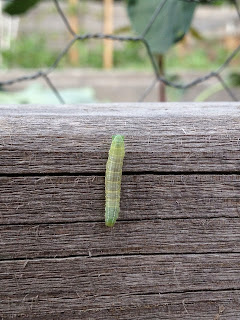
Coming off of the drought year has been hard enough on our asparagus , which needs lots of water to thrive, but we have another problem on our hands as well: After a good week or two of a small harvest, we started to have stunted, crooked spears like this one. At first I thought the tips were being nibbled by an animal, but then we noticed this: I thought they might be aphids, but upon further inspection, it turns out that those are asparagus beetle eggs. They belong to these guys:  The red beetles are spotted asparagus beetles, which I have seen before — but never this early in the season. They’ve never caused much harm. But there are also these guys:  The black ones are common asparagus beetles , and they do  cause a lot of damage, since as the eggs hatch the larvae eat their way up the stalks. They probably got a foothold during the drought as the plants were already weakened and overwintered in larger-the-usual numbers. They’ve been...
Battle Royale: Potato Beetles vs. Lady Bugs

Image
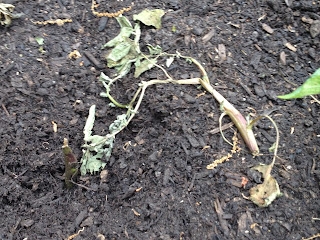
Something’s eating our potato plants: At first Kirk assumed it was cutworms because the stems looked sheared off, but we also have a whole bunch of these guys: That’s a pair of Colorado potato beetles , working pretty frantically to make lots more little potato beetles.  These bugs are notoriously destructive, and we’re losing potato plants by the day: I’m not sure if they’ll sprout again or not, but even if they do, I doubt we’ll have much of a yield by fall, especially given our short growing season. These are our red and white potatoes, but our blue ones are in a different bed — one that so far seems to be in the clear. This weekend we’ll add some row covers to the blue potato bed to try to keep it that way. We suspect that these potato beetles rode in on a load of compost from the city yard. This is ordinarily an excellent resource, but we’ve never had a problem before, and we were fine right up until adding city compost to hill up these plants....

Green Grapes, Blue Jays and Black Birds

Image
Last weekend we discovered, midway through a fierce badminton game in the back yard, that our green grapes were ripe: They looked nice and plump, but the only way to to tell with a green grape is to eat it. If you're wrong, You will have the face-puckering experience of eating a sour grape. (That taste, by the way, is a combination of citrus-sour and tongue-smacking tannin.) We screwed our courage to the sticking place and tried one, this time with happy results. Our green grapes are seedless Himrods, and they have a complex sweetness that's a little floral and honey-flavored in addition to their fruitiness. They ripen early, so are good to go some time in August.  Alas, we did not figure this out before the birds did. When we looked more closely over the grape vines to find all the rest of our Himrods, this was all that was left: It's been an unusually active year for birds in our garden, especially blue jays . As we searched the arbor for our missi...

Under Attack

Image
It's been a very hard week here in the garden. For one thing, we're dealing with quite an onslaught of winter moths . Have you seen lots of little inchworms hanging from silk threads this spring? They love maples, and are eating their way through the small red Norway maple in the back yard. I haven't noticed a big issue with the sugar maple or fruit trees out front, but it's probably just a matter of time.  They've been dive bombing out of the evergreen in the back yard also, presumably in search of greener pastures: And they've found what they're looking for: That used to be a young cabbage transplant, and almost all of them look like this now. I'd been stumped about what was eating them for a couple weeks: It's not loopers , and the damage to the stems isn't clean like a cutworm . Well, now I know. If we had known this was coming, we'd have put down the row cover as soon as we planted them. By now it might be too late....

Please Don't Eat the Roses

Image
While soaking up the sunshine and giving the perennial border a once-over (weeding, deadheading, general inspecting) this weekend, I noticed a pretty serious problem with the White-Out roses there: Not certain you see see the problem? Compare to this photo taken just two weeks ago: So where there used to be two big, full, green  rose bushes, we now have two crispy brown ones. (Although if I'm being honest, that photo above isn't without some warning signs that I failed to notice. The brown you can see easily are actually pretty harmless dried rose hips from the previous season, but when I zoomed in on my the file in iPhoto, I could see the beginnings of spotting on the good leaves.) Anyway, here's a closer look at the damage, which is extensive: The leaves look lacy and brown, crispy and dry. But with all the rain and cool temps we've had this spring, that didn't make much sense.  Some internet research brought me to the Missouri Bot...

Celery and Parsley Results

Image
This year, for the first time, we started celery and parsley from seed . That was back in February. Here's where we are today: Looking good, right?  Alas, I cannot take credit for the sudden lush growth of our celery and parsley seedlings. These are all transplants that we had to go out and buy to replace our pitiful ones. So what happened? Well, for starters, celery and parsley are notoriously difficult to start from seed. We managed a quick germination, but from there on it was very, very slow growth. They were still super-tiny in April , and died shortly after I planted them outside in early May. I'm not exactly sure what happened. We've been dealing with cutworms big-time this month, so that's a possibility. We also had some critter issues this spring. Fletch dispatched with a couple rabbits, and Kirk took out a groundhog with a lucky throw of a baseball bat (there's actually more to it than that, but I'm going to spare you there Gam...

Groundhog Damage

Image
Earlier this summer, I blamed a baby skunk (and its presumed nearby family) for destroying our broccoli and Brussels sprouts. Despite putting a fence around our brassica bed, we were still losing branches off of those crops: But not, as you can clearly see in the photo above, any nibbles off the cabbages. What a strange creature! It takes all the trouble to get in around the fencing, and nibbles on less-than-ideal remnants of broccoli and Brussels sprouts while completely ignoring big, beautiful cabbages than are a foot away. Well, up until earlier this week, that is. That's when, during a stroll to the compost pile, I discovered that A) the skunk had finally sampled a bit of a cabbage, and B) it's not a skunk at all, but a groundhog! He saw me and ran, giving away his point of entry in the process. So clearly there's a major weakness in our chicken wire fencing around the "C." The "doorway" to the keyhole just has loose fenc...

Something Stinks

Image
Something is eating our broccoli. Again . These plants are obviously too far gone to rescue, but I kept them around as a decoy to try to keep the culprit away from all of our other plants. That worked for a while, until it found our big brassica bed. We originally thought that a groundhog was to blame (as has been the case in the past ), but then we saw (and smelled) this guy: That's a baby skunk. In this photo, it is stumbling kind of blindly along the fence, looking for its way out of the sudden rainstorm that popped up. Some people would feel sorry for it, but where there's a baby, there's a family. And I don't think Fletch is going to touch this problem with a ten-foot pole. Turns out the skunk is rather a gourmand —  and a finicky one at that. He only eats broccoli. This is good news for everything else in the garden (although he looks to have tasted and then spit out peas, and nibbled the tops of some parsnips before moving on). Good news al...

Attack of the Cutworms!

Image
Last weekend I transplanted three tomatillo plants to the garden. They were looking really good: big, strong plants ready to take off out in the sunshine. Here's what we have left: Only the one on the right remains, and that one has been damaged pretty severely. The culprit? Cutworms. Their tell-tale destruction looks like this: Cutworms are the larvae of various moths. They overwinter in soil, and in the spring evenings they feed on the stems of new garden plants. They basically shear off the stem, eating a little bit near the ground and leaving the rest of the plant to die. I think I hate them most because they are so wasteful. At least a groundhog or  turkey has the decency to enjoy the whole vegetable . Some quick internet research revealed that there is such a thing as a turnip cutworm, and since we had turnips in this bed previously, I'm guessing that this is our particular pest. I noticed that some of the carrots we overwintered in this bed were ch...

Bulbs for the Cutting Garden

Image
This afternoon I planted bulbs in the cutting beds: All told, I put in 150 bulbs today. They included several varieties of daffodils, tulips, hyacinths, irises, allium, and lilies. For the cutting garden I'm not too worried about planting in a natural-looking way – straight rows to fit in as many as possible will do just fine in a place where most of them are meant to be cut down to bring inside anyway.  Faithful readers will recall that the bulbs in the perennial border were either devoured or relocated by our rapacious squirrel population. This time, we are working to prevent damage from the get-go: We covered the whole bulb bed with a roll of chicken wire. Instead of burying it, we screwed wooden battens directly to the edges of the raised bed to hold the chicken wire in place: In the spring, the green shoots should find their way through the holes in the wire, but squirrels will have a difficult time burrowing in. This solution isn't feasible...

Nature: Simultaneously Gross and Awesome

Image
While picking tomatoes yesterday, we came across this: It's the biggest, grossest caterpillar we've ever seen! A quick google search of "big caterpillar with white things" showed us right away that this was a tomato hornworm , which is a pretty big garden pest that can defoliate your tomatoes in just a day or two. Ours doesn't seem to have done much more damage other than just eating the leaves of the branch it's currently on, and we couldn't find any more (although, according to the internet, they are notoriously hard to spot — they are pretty much the exact same color as the tomato leaves, for one thing). Kirk was about to pick it off the plant when I read a little further to find out what the white things are ... Parasitic Braconidae wasp larvae. So it turns out that those white things are miniature cocoons for wasp larvae. The eggs are laid when the wasp injects them into a hornworm, and as the larvae grow the EAT THEIR WAY OUT OF THE HO...

The Squirrels Are Back in Town

Image
Not that they ever really left (well, except maybe that one that, according to our neighbors, got eaten by the hawk), but the squirrels are back. With a vengeance. This time they are tag-teaming our corn: They run from the back fence into the corn and back again, one after another. There's not much we can do about it — they can climb over anything we put around the corn, short of building a greenhouse for it. So we walk around the yard picking up what's left of corn cobs and husks. Sometimes they leave scraps with actual kernels on them, which I hand directly over to the chickens. At least someone is getting some corn. To be fair, we did  get a tiny bit of corn. But it's not great, as you can see when I put an average-size tomato in the photo for scale: These ears are pretty tiny, and what the squirrels are getting aren't any bigger. I don't know if it's due to the dry weather, the variety, or the slightly shady bed, but corn hasn...