Posts

Happy Harvest

Image
Though the loss of the bees was very sad, not everything about this winter was a disaster. For example, we had a large bed of winter carrots that happily spent the season underground. In this case, the warm February weather brought on an early thaw and allowed us to access them throughout the spring. But as we were about to revamp their bed for a new planting of cabbages  by April, it was time to dig the rest of them up:  Carrots that are harvested after enduring freezing temperatures are very sweet, so these are delicious roasted plain or diced into soups. At this point they are purely cooking carrots, though, as their crunch is long gone thanks to the weird free/thaw cycles this year. So we had a mini carrot festival this month, enjoying them in all kinds of dishes. Ginger Carrot Soup was a favorite: To make it, Kirk sweated some leeks (another vegetable that we overwintered underground) in butter and added rough-cut carrot chunks to the soup pot ,...

Sad Harvest

Image
When we last looked in on the bees in February , they were doing well. The  hive that had swarmed  had made it through the winter, and the bees were foraging for pollen during the unusually warm February weather. We even saw the queen when we took a peek, and they had honey stores left. To be safe, we gave them a few extra combs from the hive that had died off over the winter. We figured they had only to get through a few more weeks. And then March happened. Temperatures plummeted, and the whole month was far colder than usual — as if February and March had switched places . We went from a high of 76 on February 21 to a low of only 12 on March 18, and it struggled to get above 40 for most the March. The average temperature for the month was 35 degrees. That was too much cold coming on too fast for the bees to reorganize after they had broken cluster to forage on the warm days during the last two weeks of February. Bees huddle together and beat their wings to produce eno...

2018 Master Plan: The Swingset Quadrant

Image
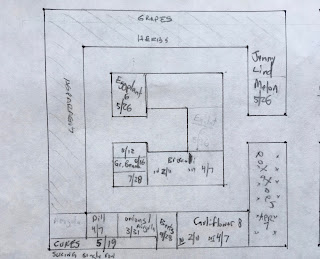
Continuing around the garden to the swingset quadrant, we have our planting plan for the 2018 season: On the left, as always, is the asparagus . It’s not nearly as productive as it once was, so this spring we will try renovating it by resetting the crowns lower in the earth and adding some lime to counteract the soil acidity from a nearby evergreen tree.  Across the top are perennial grapes and herbs — nothing to see there.  Along the right side is space for Jenny Lind melons, which is a new variety of small, green fleshed melons. This is an heirloom variety popular among the Pennsylvania Dutch, and we got the seeds on a trip to the Landis Valley Village and Farm Museum last spring. There’s also a potato patch. Along the bottom is a very small length of trellised cucumbers, which will be for slicing. We have tons of pickles from last summer, so we won’t be planting any pickling cukes at all. There’s also an assortment of dill, arugula, beets and cauliflo...

2018 Master Plan: The Patio Quadrant

Image
We made our garden plan back in February, but I forgot to document it. I was reminded of this when we pulled out the plan to actually start planting. It hasn’t been warm — it’s snowing as I write this — but the ground has thawed and we can get started with our hardiest cool-weather plants. The leeks we ordered came in the mail, so we had to get them in the ground. We bought transplants instead of doing them from seed this year, and they are about as big around as a pencil — much bigger than the tiny strings we’ve managed to get starting them on our own. These are much easier to work with, and I’m certain they’ll have a better survival rate than our tiny seedlings, so this looks to be a good investment. Behind the cold frame you can see a few of last year’s leeks — these are the stragglers we haven’t harvested yet. Usually when we plant in March, we’re out of luck when it comes to compost. That’s because the City Yard doesn’t open until April and our pile is usually frozen....

Repotting Seeds

Image
In theory, we should be planting peas and onions next weekend, but this is the state of things in the garden today: A series of four nor’easters and below-average temps have set us behind schedule for planting. I imagine the snow will be gone by next weekend, but I’m not sure if the soil will be ready to work or if it will be too frozen or too wet or too something else.  I’m not feeling in much of a rush this year since it’s been so miserable outside this month. The local weather reporters have taken to saying that March is the new February, and they’re right. Since we appear to have some additional time on our hands, I transplanted our broccoli, cabbage and cauliflower seedlings into peat pots: It should be noted that these seedlings look great  this year. I attribute this to more diligent use of our lamp to make sure they were getting enough light on all those cloudy, stormy days: The brassica is scheduled to be transplanted into the garden in t...

It’s Spring Somewhere

Image
We’ve been socked with three nor'easters in two weeks, all of which resulted in snow that canceled school. We also lost power for a couple days, which is not at all fun  in the middle of winter.  So I was very happy to ditch the crummy weather and head south to North Carolina for the weekend. They’re a good six to eight weeks ahead of us when it comes to the ground warming, so my trip to Reynolda Gardens in Winston-Salem was a hint of what is eventually to come this spring. Enjoy! It was nice to be reminded of green grass, pansies and daffodils, but I did have to return to an additional 18 inches of snow at the end of my trip. Sigh.  Did I mention there’s a possibility of another  nor’easter next week? March is the new February, it seems.

Bee Check

Image
We had an incredibly warm day last week — 75 degrees in February! — which was perfect for checking in on the bees. You can’t open the hive when it’s colder than about 55 degree for risk of chilling them, but they were all out and about enjoying the weather anyway, so we dove in. As suspected, the hive of bees that swarmed is still going strong, but the ones left behind in the original hive didn’t make it. I moved the mouse guard away from the door of the good hive to allow the bees access to all three entrances, and this gave them more room to start bringing out the dead. One of the more disconcerting things about a wine hive is that the bees can’t break free of their tight cluster when it’s cold, or they’ll freeze to death. That means that chores like carrying dead bees out of the hive have to wait until spring. There are a lot  of dead bees in there. Still, as soon as I moved the door, they started carrying out little bee corpses. I also put out some extra sugar water fo...